
What's Next for FitFocus
FitFocus has evolved. From a program builder for individual coaches into the operating system for fitness businesses ready to scale. The story behind the change, what stays, and what is coming next.

I wanted to write something public about where FitFocus is heading, because the platform looks different to how it looked a year ago and the people landing on this site for the first time deserve to know why.
This is the version of the story I would tell you if we were sitting across a table. No marketing polish. Just the actual thinking behind what we have built and what is coming next.
Where FitFocus Started
When we first built FitFocus, the goal was simple. Give coaches the most efficient program builder on the market, so they could spend less time on admin and more time growing their business. That was the whole proposition. Build programs faster. Look polished doing it. Reclaim hours every week.
It worked. Hundreds of coaches built their businesses on FitFocus v1.0. Many of them are still on it today. The product did exactly what we promised it would do, and the early supporters who chose us when we were unproven are a meaningful part of why we are still here.
But the longer we spent inside the product, the more we kept running into the same tension.
The Tension That Forced a Decision
Coaches were asking us for more. Not different. More. They wanted programming, yes, but they also wanted client management, messaging, nutrition, scheduling, lead capture, branded apps, team management, and operational tools that turn a coaching practice into a real business.
We could have kept adding features to the existing product. Most software companies would have. But the longer we considered it, the more we realised we would be building two different products under the same roof. Each one compromising the other. A lightweight tool for coaches who wanted simplicity. A heavyweight tool for businesses ready to scale. Neither one done justice.
Health and fitness, as a category, is about more than sets and reps. The coaching businesses that succeed long-term are ones that operate as serious businesses, with serious infrastructure, serving clients across the whole experience of working with a coach. We wanted to build for those businesses. We also wanted to keep serving the coaches who valued simplicity above everything else.
Those are different products. Trying to be both was holding both back.
The Move That Resolved It
In 2026, we acquired QuickCoach.
QuickCoach has been around for years. It has a global community of coaches who use it to deliver programming and run lightweight coaching practices. The community is loyal. The product is loved. The team that built it cared about the right things. When the opportunity to acquire it came up, the decision was straightforward, because it solved the tension we had been wrestling with.
Moving forward, the two products serve different parts of the market. QuickCoach is our home for coaches who want a simple, lightweight tool that handles programming and client management without complication. It is the best on-ramp for coaches at the start of their online journey, and the natural fit for coaches whose business does not need the full operating-system layer.
FitFocus v2.0 is something bigger. It is the operating system for fitness businesses ready to scale. Programming, messaging, nutrition, scheduling, lead capture, white-labelled client apps, team management, and the operational infrastructure that turns a coaching practice into a real business. All in one platform. Built for the coaches and the teams whose work has outgrown lightweight tools.
Two products. Two clear purposes. Both built with the same care.
Existing FitFocus v1.0 users keep their workspace and their data, and we remain fully committed to maintaining v1.0 for the coaches who built their businesses on it. From early 2026, we are no longer accepting new account registrations for FitFocus v1.0, but for everyone already on the platform, nothing changes. Customer support continues at the same standard, and there is no expiry date on that commitment. The rest of this article is about what v2.0 is and where it is heading, for the coaches considering it for the first time.
What FitFocus v2.0 Is
The clearest way to describe v2.0 is this: it is the coaching platform we wished existed when we were trying to scale FitFocus v1.0 itself.
A platform that consolidates the seven or eight tools most premium coaching businesses are stitching together. A platform that puts the client experience at the centre, with a white-labelled app the clients actually open and engage with. A platform that scales from a solo coach with a serious practice up to a multi-coach team without forcing the business to migrate to something else at the growth point. A platform built for the long arc of a fitness business, not just its early stages.
Every part of the product is built around one underlying belief. The coaching is the product. Everything the platform does should make the coaching better, the client experience richer, and the operational layer lighter. If a feature does not serve those three things, it does not belong.
The operational layer is where most coaching businesses quietly stall. The owner becomes the bottleneck, and the business stops when they stop. We wrote the owner-dependency test to make that visible, and it is the clearest description we have of the problem the operational layer solves.
That is the brief we have been building against for the past year. v2.0 is the result.
What This Means for the Broader Ecosystem
FitFocus and QuickCoach now sit alongside each other inside the Hale Health ecosystem. Two products, one team, one philosophy. We use what we learn from each platform to make the other one better. A pattern we identify in one informs how we build the other. The shared infrastructure means both products benefit from work that would otherwise have to be done twice.
For coaches, this matters in a quiet but real way. The platforms are not built in isolation. They are built by a team that sees the full spectrum of how online coaching businesses actually work, from a coach with their first five clients up to a multi-coach business serving hundreds. Both products get better because of that shared vantage point.
What We Are Building Toward
I want to be careful not to make promises about a roadmap I cannot fully predict. Software products evolve in response to what their users actually need, not in response to what their founders thought they would need 12 months earlier.
What I can say honestly is that v2.0 is the starting point of a longer arc, not the end of one. The platform will keep getting better. The integrations will keep expanding. The operational layer will keep deepening. The white-labelled experience will keep getting more polished. We have a clear view of where the product needs to go over the next two to three years, and we are well-resourced to get it there.
The coaches who run the most ambitious fitness businesses of the next decade are going to need software that matches their ambition. v2.0 is built to be that software. Not for everyone. Specifically for the coaches whose work belongs at the serious end of the category and who want a platform that takes their business as seriously as they do.
A Closing Thought
Rebrands are usually about marketing. This one is not. The change in the FitFocus product reflects a real change in what we are building and who we are building it for. The new positioning is not a paint job. It is the honest version of what the product has become, and the deliberate version of what it is becoming next.
To the coaches who supported FitFocus v1.0: thank you. We are here because of you, and the next chapter is built on what you helped us learn.
To the coaches landing on this site for the first time: welcome. If your business is at the stage where the operating system underneath it has started to matter, you are in the right place. We would love to show you what we have built.
Either way, we are glad you are here.
Nicholas Clancy is the founder of FitFocus. FitFocus is part of the Hale Health ecosystem alongside QuickCoach.
To see FitFocus v2.0 in action, book a 30-minute demo.

Keep reading
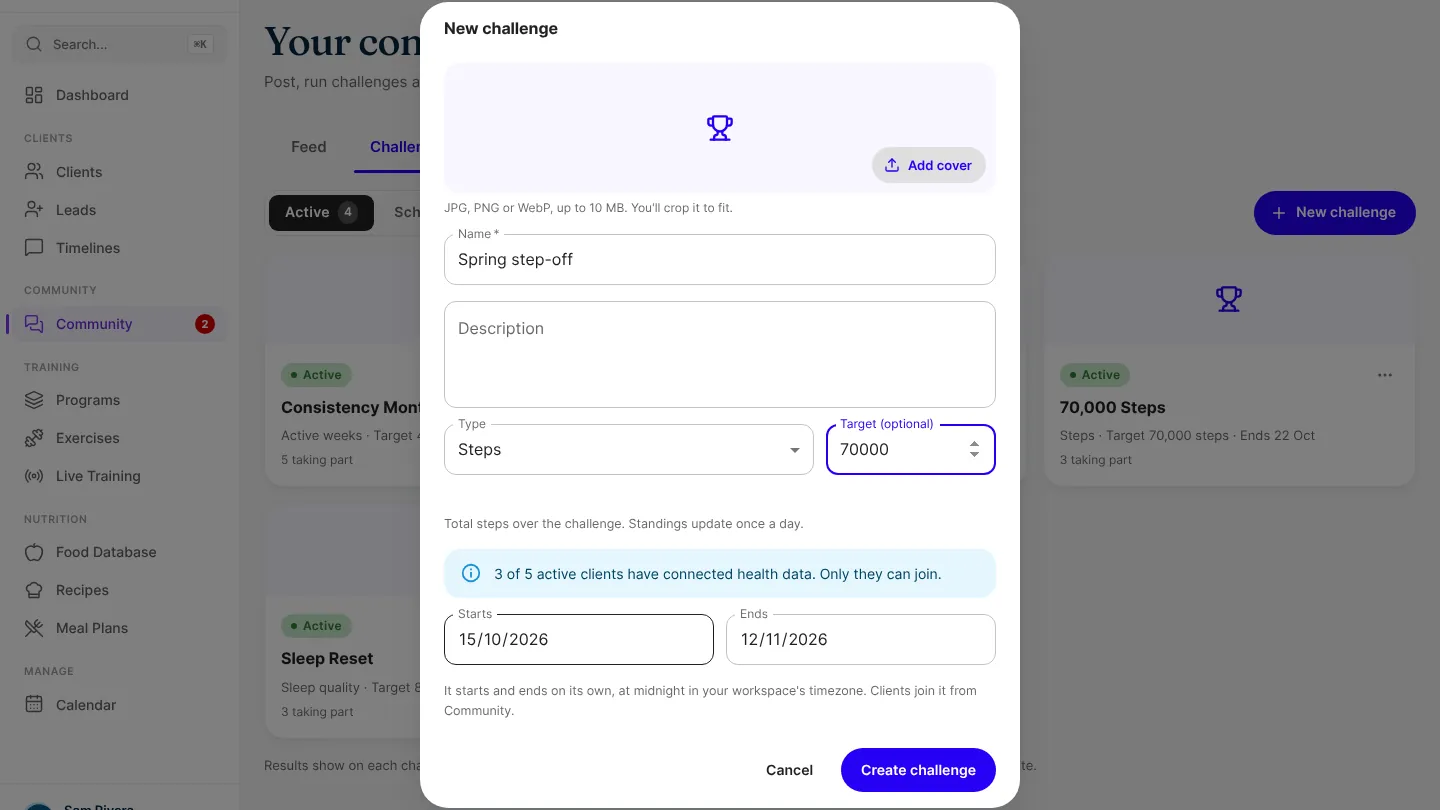
Run a steps, active calories or sleep quality challenge for your clients
Community challenges can now count steps, active calories or sleep quality. Set the dates, and clients who've connected their health data in the app can join.

The Exercises Coaches Are Programming Less (And What Replaced Them)
Nothing was banned. Five once-standard movements sit at the thin end of premium programming now: the crunch, the upright row, behind-the-neck work, good mornings and unstable-surface loading.

The Movements Every Coach Programs, Whatever the Goal
Powerlifting, physique, rehab, CrossFit: the specialties barely resemble each other. Across 70,000 logged workouts, the same five movement patterns sit under all of them.