
How to Handle a Client Asking for a Discount (Without Losing the Deal or Yourself)
Every coach gets a client asking for a discount eventually. The honest playbook: what to say, when to hold your price, and when to flex the offer instead.

Every coach gets this request eventually. A client asking for a discount rarely announces itself cleanly. It is a prospect on a sales call who pauses, looks slightly uncomfortable, and asks if there is any flexibility on the price. It is an existing client who emails saying they love working with you but money is tight and is there any way you can help. It is a friend-of-a-friend referral who assumes mates rates apply. Whether you run an in-person studio or a fully online coaching practice, the request lands the same way.
How you handle these moments shapes your business more than almost any other single decision you make. Hold the line poorly and you end up with a roster of clients trained to push you on price for the rest of the relationship. Flex thoughtlessly and you train every new client to expect the same. Refuse robotically and you lose deals you should have closed differently.
The reason most coaches handle this badly is that nobody ever taught them how. There is plenty of writing about how to set your prices. There is almost nothing useful about what to do in the actual moment when a real person looks you in the eye and asks for less.
This is the playbook. It assumes you have already done the work to set a price you can defend. From there, it walks through what is actually going on in the conversation, the responses that work, the responses that do not, and the small adjustments that change the outcome more than coaches realise.
First, Understand Why People Ask
Discount requests come from one of three places, and your response should differ depending on which one you are dealing with. The conversation goes off the rails when coaches treat all three the same way.
Type one: real financial constraint
The prospect or client genuinely cannot afford the full price right now. They want to work with you. They are not testing you. They are looking for a way to make the relationship work within real constraints. This is the most common type, and it is the easiest to handle well if you spot it.
The signals: they ask once, politely, with some embarrassment. They specifically reference their budget or financial situation. They do not push when you respond. They are looking for a yes-or-no answer, not the start of a negotiation.
Type two: reflexive negotiation
The prospect treats every transaction as something to push against by default, regardless of price or value. This is not really about your pricing. It is a personality pattern. Discounting for these clients does not produce gratitude. It produces another negotiation, on the next thing, and the one after that.
The signals: they ask early in the conversation, before they have asked much about the actual coaching. They use language like "what is your best price" or "can you do better." They keep pushing if you give a small concession. The discount request is an opening move, not a final question.
Type three: not-yet-convinced
The prospect is using the price conversation as a polite way to express that they are not actually sold on the value yet. The discount request is a stand-in for "I am not sure this is worth it." Discounting will not solve this because the price is not the real objection.
The signals: they ask vague questions about value before getting to price. They want assurances about outcomes. They keep coming back to whether your service will work for their specific situation. The discount request is a symptom of an unresolved confidence problem.
What to Say When a Client Asks for a Discount
Each type requires a different opening response. Get the diagnosis right and the conversation goes somewhere productive. Get it wrong and you either lose the deal or close the wrong deal.
Responding to type one: real constraint
Be honest. Hold your full price. Offer a different shape of relationship that fits the budget rather than discounting the same offer.
A response that works:
"Thanks for being upfront about that. The full programme is what it is, and I do not discount it because it would not be fair to clients paying full price. What I can do is offer a lighter version. Fewer check-ins, less direct messaging, monthly programming instead of weekly. It still gets you most of the value at a price that fits where you are right now. Want me to send you what that looks like?"
Why it works. You have not punished the client for asking. You have not abandoned your pricing. You have given them a real path forward and protected the value of your full offering. Many type-one clients accept the lighter version, work with you for a while, and upgrade to the full programme later when their situation changes. That is a much better long-term outcome than discounting the full programme today.
Responding to type two: reflexive negotiation
Decline politely. Do not negotiate. Make the pricing conversation short and clear, then either move forward at full price or let the deal go.
A response that works:
"The pricing is what it is. It reflects what is in the programme and the work I am going to do for you. I do not negotiate on it because the clients who pay full price would not appreciate me discounting for some and not others. If the price works for you, I would love to work together. If it does not, I completely understand and I am happy to point you in the direction of other options."
Why it works. You have closed the negotiation cleanly. The reflexive negotiator now has a binary choice: pay or walk. Many of them pay. The ones who walk were going to be exhausting clients anyway. Either outcome is acceptable. The bad outcome is the long, drawn-out negotiation that leaves both sides resenting the eventual deal.
Responding to type three: not-yet-convinced
Do not address the price at all. Diagnose the underlying confidence problem and address that first.
A response that works:
"Before we talk about price, can I ask what is making you hesitate? Sometimes when people ask about discounts, what they are really asking is whether the programme is going to deliver what they need. Tell me what you are actually unsure about, and let me see if I can give you a better picture of how this would work for you specifically."
Why it works. You have surfaced the real objection. If you can address it, the price conversation usually resolves itself. If you cannot, the client was never going to be a fit and you have learned that quickly without giving anything away on price. The mistake is to offer a discount in response to a confidence problem. The discount does not fix the confidence, and now you have a client who is paying less and still not convinced.
What Not to Do, Ever
A few responses that almost always make things worse, regardless of which type you are dealing with.
Do not apologise for your pricing. The instinct to soften the conversation by saying things like "I know it is a lot" or "I get that it is expensive" undermines the price you are about to charge. The price is the price. It does not need an apology. Apologising signals that you yourself are not sure it is worth what you are charging, which is exactly the wrong signal to give the person deciding whether to pay it.
Do not split the difference instinctively. Coaches who give an immediate small discount because it feels collaborative end up signalling that the original price was negotiable. Once that signal is given, every future conversation with this client carries the same expectation.
Do not over-explain the value. The instinct when someone asks for a discount is to defend the price by listing everything they get. This rarely works. The prospect did not ask for more value. They asked for a lower price. Listing value at this point reads as defensive rather than confident.
Do not promise something you cannot sustain. Some coaches discount with phrases like "this one time only" or "let us see how it goes for the first month." These almost always become permanent. Whatever you offer in the discount conversation, assume it is what you will be charging this client for the entire relationship, because almost certainly it is.
Do not try to win the negotiation. The goal of a discount conversation is not to win. The goal is to either close a good-fit relationship at sustainable pricing or to walk away cleanly. Trying to "win" the conversation typically means you concede something to keep the deal, and the client knows they extracted it. That is not a win for you.
When You Should Flex (And How to Do It Without Losing Yourself)
There are situations where some form of flexibility is the right move. The trick is to flex on terms that do not erode your pricing structure.
Things you can flex without devaluing your offering: the length of the commitment, the cadence of the contact, the scope of what is included, the payment schedule, the start date. Each of these is a real lever that can make a relationship work for a constrained client without telling the rest of your roster that your pricing is negotiable.
Things you should almost never flex: the per-month or per-package price for the same offering, the inclusions on a published package, the standard terms you publish on your website. These are the structural pieces that hold your business together. Touching them in a one-off discount conversation creates problems that outlast the deal.
A useful frame: change the offer, not the price. If a client cannot afford your standard offer, the answer is a different offer at a different price, not your standard offer at a discount. The two look similar in the moment. They are very different over the next 12 months of the relationship.
The Long Game
Coaches who handle discount requests well end up running calmer, more profitable, more sustainable businesses. They have rosters of clients who respect their pricing, refer their friends at full price, and treat the relationship as a serious investment because it was set up as one from the start. It is the same kind of calm that comes from running your week on a real structure instead of reacting to whatever lands in the inbox.
Coaches who handle discount requests badly end up with rosters trained to negotiate, lower margins, more churn, and an ongoing low-grade resentment about pricing that bleeds into every other part of the business. None of which has to happen. The conversations are not actually that hard once you have a framework. The framework is everything in this article.
Set your prices well. Diagnose which type of request you are dealing with. Respond to each type appropriately. Do not apologise. Do not split the difference reflexively. Change the offer, not the price, when flexibility is genuinely warranted. Hold your structure. And when the price you hold starts to sit behind the current rate, the arithmetic of a rise across an existing roster, including how many clients you can afford to lose, is in our guide to raising prices on existing clients. Trust that the right clients will pay what you are worth, and the wrong ones will reveal themselves quickly.
That is the playbook. The next time the question lands in front of you, the conversation will feel meaningfully smaller than it used to.
Nicholas Clancy is the founder of FitFocus. FitFocus is part of the Hale Health ecosystem.
FitFocus is the coaching platform built around the kind of operation that supports premium pricing. A white-labelled client app, polished onboarding, and consolidated workflows. Software that signals you run a serious business, so the pricing conversation is easier to hold. Book a demo to see how it fits the way you actually coach.

Keep reading
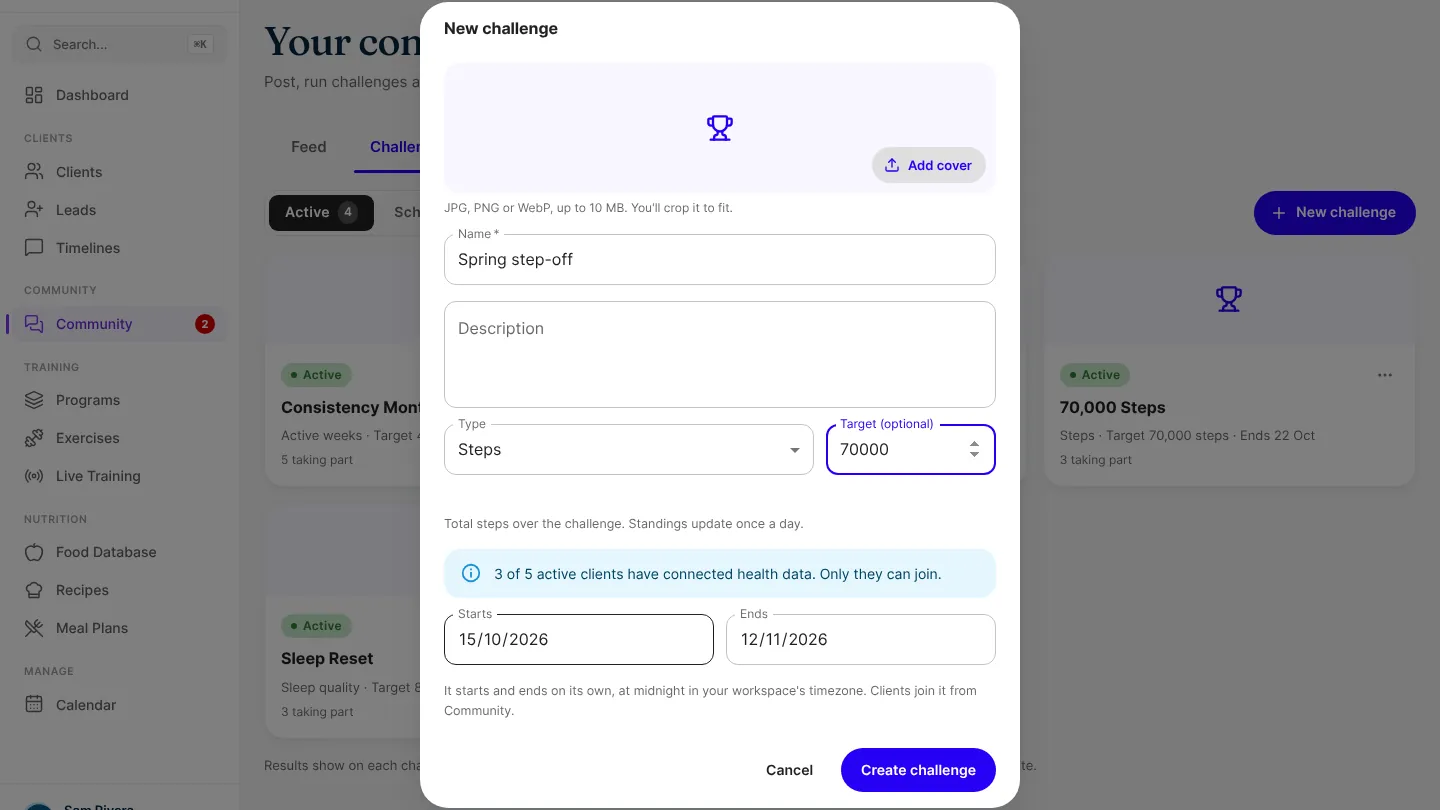
Run a steps, active calories or sleep quality challenge for your clients
Community challenges can now count steps, active calories or sleep quality. Set the dates, and clients who've connected their health data in the app can join.

The Exercises Coaches Are Programming Less (And What Replaced Them)
Nothing was banned. Five once-standard movements sit at the thin end of premium programming now: the crunch, the upright row, behind-the-neck work, good mornings and unstable-surface loading.

The Movements Every Coach Programs, Whatever the Goal
Powerlifting, physique, rehab, CrossFit: the specialties barely resemble each other. Across 70,000 logged workouts, the same five movement patterns sit under all of them.