
A Week in the Life: How I Actually Run My Coaching Business
A real online coach's actual week. The programming day, the check-in rhythm, the messaging cadence, the admin batching. How modern coaches who run premium practices actually structure their working week.

I get asked the same question a lot from coaches at the start of their online journey. What does your week actually look like? What do you do on Mondays? When do you write programs? When do you check in? How do you stop the whole thing from running you into the ground?
It is a fair question, and the version that gets answered on Instagram is mostly useless. Build great programs. Stay close to your clients. Use systems. None of that tells you what to actually do at 9am on a Tuesday when you have 25 clients waiting on programming and your dog has just thrown up on the rug.
I learned the structure I am about to walk you through the hard way. The first 18 months of running my online practice at STEALTH Conditioning, I had no rhythm at all. I would write a program on a Wednesday afternoon because a client messaged me wondering where it was. I would do check-ins at 10pm because that was the first quiet moment in the day. I would respond to messages every time my phone buzzed and lose three hours a day to context switching without realising it. I was working harder than I had ever worked and my clients were getting less than they deserved.
The week below is what I built once I worked out that the problem was not how hard I was working. It was that I had no structure to the work. Take what is useful. Ignore what is not.
The Underlying Principle: Batch Everything
Before I go through the days, the single most important thing I have learned about running an online coaching business is that batching is not optional. It is the difference between a business that scales and one that drowns.
What batching means in practice: every type of work has a designated time, and you do all of that type of work in that time, and you do not do it at any other time. Programming is on programming days. Check-ins are on check-in days. Messaging is at messaging times. Admin is on admin days. The temptation to do everything every day, in response to whatever lands in your inbox, is the thing that kills most coaches' weeks.
The reason batching works is not just efficiency. It is psychological. When you batch, you stay in one mode of thinking for an extended period, and your output in that mode improves. When you switch modes constantly, you do worse work in every mode. A morning of programming, uninterrupted, produces better programs than a morning of programming-plus-messaging-plus-admin. By a lot.
Every day below is structured around this principle. The specific days might shift around for you. The principle does not.
Monday: Program Building Day
Monday is the most important day of my week. It is the day I build all the programs for my entire roster for the coming week. Block from 8am to 1pm. No meetings. No calls. No client conversations. Phone in another room. Pure programming.
I work through the roster in alphabetical order, which sounds dumb but the order matters. If I work in order of "client I am most excited to program for," the back half of the roster gets the programming version of leftovers. Alphabetical is unromantic, fair, and means everyone gets me at full focus.
Each client gets a quick review of their previous week's data and feedback, and the next week's program gets built off that. Most clients take 10 to 20 minutes once you have your templates dialled in. New clients or clients with specific complications, like an injury flaring up or a holiday coming, take longer. I have a list of those flagged at the start of the morning so they get more attention rather than getting rushed at the end.
A few specific things that have improved over time. I work in the same physical space every Monday morning. I have my coffee at the same time. I have the same playlist on, which I will not name because it is embarrassing. The ritual sounds dumb, but it primes the brain. The mode is recognisable. The output is better.
I also keep a running list of small adjustments I want to make to client programs as the previous week unfolds. So when programming day comes, I am working from notes rather than memory. Memory is the enemy of consistency in coaching. Notes are the friend.
Tuesday: Check-in Day
Tuesday is when I do all my client check-ins. Same logic as programming day. One mode, one block, one focused morning.
Check-ins for me are not generic. Each client gets a real read of their previous week. What they completed. What they did not. What their feedback flagged. What their nutrition and recovery looked like. Anything in their messaging that suggested life was complicated. I write a substantive response that addresses what actually happened, not a templated "great week, keep going" line. Templated check-ins are how clients learn that their coach is not really paying attention. I have lost clients to this in the past, before I worked out that doing fewer, better check-ins beats more, lazier ones every time.
A good check-in takes me 10 to 15 minutes per client. Across a roster, that is two to three hours of focused work. I do it Tuesday morning before any meetings, in the same physical block I do programming. Same ritual, same mode.
The reason this matters more than coaches realise: the check-in is the moment the client most acutely feels coached. The program runs in the background. The check-in is where the relationship is actively delivered. A coach who phones in their check-ins is not really coaching. A coach who does check-ins properly is doing the work that retention is built on.
Wednesday: Calls, Demos, and Sales Conversations
Wednesday is for synchronous client work. Onboarding calls with new clients. Quarterly review calls with existing clients. Sales conversations with prospects. Anything that requires me to be on a video call.
I batch these because video calls drain energy in a way written work does not, and recovering from a call takes longer than the call itself. Doing them all on one day means the recovery cost is contained.
I structure the day with calls back-to-back, mid-morning to mid-afternoon, with a 15-minute buffer between each. The buffer is non-negotiable. It lets me write notes from the previous call, mentally reset, and walk into the next one without spillover.
I also book all consultations and intro calls on this day. Coaches who let prospects book consultations whenever they want end up with calls scattered through the week, which kills the rhythm of every other day. One day for synchronous work. The rest of the week stays asynchronous.
Sales calls are also where the price conversation happens, so it pays to have a plan for when a client asks for a discount before you are on the call. Going in without one is how coaches end up discounting on instinct.
Thursday: Content and Business Day
Thursday is for everything that is not directly client-facing but matters for the business. Content creation. Email newsletter writing. Social posts. Strategy work. Reviewing the business numbers. Reading and learning. Any longer-form work that is not specific to a client but moves the business forward.
This is the day most coaches accidentally skip, then wonder why their business is not growing. The work that is not in front of a client today is the work that determines whether the business has any clients in 12 months. Content. Brand. Education. Financial discipline. Strategic thinking. None of it has a deadline that forces it onto the calendar, which is why most coaches let it slip.
I treat Thursday as immovable. The business gets its own day, the same way clients do.
Friday: Messaging, Admin, Wrap-Up
Friday is for closing the loops. All the messaging that has accumulated through the week, batched and answered. All the admin that has piled up. Any client paperwork. Any invoices. Any onboarding that has been initiated and needs to be progressed. Any tasks that have been sitting on a list for the week.
I deliberately leave most of this to Friday because most of it is not actually urgent. Coaches who try to clear their inbox daily end up doing nothing else. Coaches who let the inbox accumulate to one focused block at the end of the week clear it faster, with better answers, and protect the rest of their week from being eaten by reactive work.
There are exceptions. Anything genuinely urgent gets handled when it lands. But the bar for urgency is high. Most messages can wait a few days, especially when the client knows the coach's rhythm and trusts that they will get a thoughtful response on Friday rather than a rushed one on Tuesday.
I finish Friday early, intentionally. The week needs an end. Coaches whose work bleeds into Friday evening and Saturday morning are running unsustainably, and the longer they do it, the worse it gets.
What Makes This Rhythm Actually Work
The week I have just walked through depends on infrastructure. The batching only holds together if the tools you use support it rather than fight it. A few things matter:
A coaching platform that handles everything in one place. The single biggest time waste for an online coach is switching between tools. Programs in one app, messages in another, payments in a third, scheduling in a fourth. Every transition costs time and breaks focus. The platforms that consolidate programming, messaging, nutrition, scheduling, leads, and a branded client app into a single product remove most of the context-switching that kills batched workflows. FitFocus is built around exactly this kind of consolidation, which is why it is the platform I would point coaches at when they ask me about this part of the operation.
Templates that do most of the programming legwork. Building templates for the programs you run most often, strength foundations, hypertrophy blocks, fat loss phases, hybrid setups, makes programming day faster because most clients are working from a template you are adjusting rather than a blank page you are filling. Any decent coaching platform should make this easy to do. The same templates become the delivery standard the day a second person has to produce the work, which is the moment to start systemising a coaching business properly.
A messaging system that does not feel like WhatsApp on fire. A coach with 30 clients cannot run their messaging in WhatsApp. The volume crushes you. A proper coaching messaging inbox, with search, snooze, and saved replies, makes Friday batching actually possible. Without it, the messaging tax slowly eats every other day.
Branded client app on iOS and Android. This is the piece that ties the whole client experience together. Clients open one branded app, see everything in one place, and the experience feels designed rather than assembled. Without that, a lot of the operational work gets undermined every time the client encounters a generic touch point.
What I Would Tell a Coach Starting Out
If you are early in your online coaching journey and trying to figure out how to structure your week, do not copy my exact days. Copy the principle. Batch every type of work. Give each type of work its own day or block. Protect the blocks ruthlessly. Resist the temptation to do everything every day in response to whatever happens to land in your inbox. That is the version of advice that took me 18 months and a near-burnout to actually internalise. If you are not sure where your own hours actually go, run a two-week admin audit before you set the blocks, because batching a week you have never measured is guesswork.
The coaches I see succeed at this are the ones who treat their week as a designed structure rather than a reactive flow. The coaches who burn out are the ones who let everything happen all the time. I have been on both sides. The first one is harder to set up and infinitely better to live in.
The infrastructure makes a difference too. Every tool that fragments your day costs you focus. Every tool that consolidates your work protects it. Choose accordingly. The platform you run on is one of the most consequential choices you make about how you live your weeks, not just how you deliver to your clients.
Coaching well is hard. Running a coaching business well is harder. Doing both for years without burning out is hardest. The week structure is the foundation. Get it right, and the rest of the business follows.
A designed week buys back capacity, and eventually you run out of capacity to buy back. That is a different problem with a different set of answers, and the FitFocus team has written it up in why a full coaching business stops growing.
Nick Hogan is the founder of STEALTH Conditioning and a coach at Olympus Gym in Sydney. He holds a Bachelor of Sports and Exercise Science from Western Sydney University and specialises in hypertrophy.
FitFocus is the kind of platform the article above describes. White-labelled client experience, programs, messaging, nutrition, check-ins and leads in one place. Book a demo.

Written by
Nick Hogan
Founder of STEALTH Conditioning and a coach at Olympus Gym in Sydney. He holds a Bachelor of Sports and Exercise Science from Western Sydney University and specialises in hypertrophy.
Keep reading
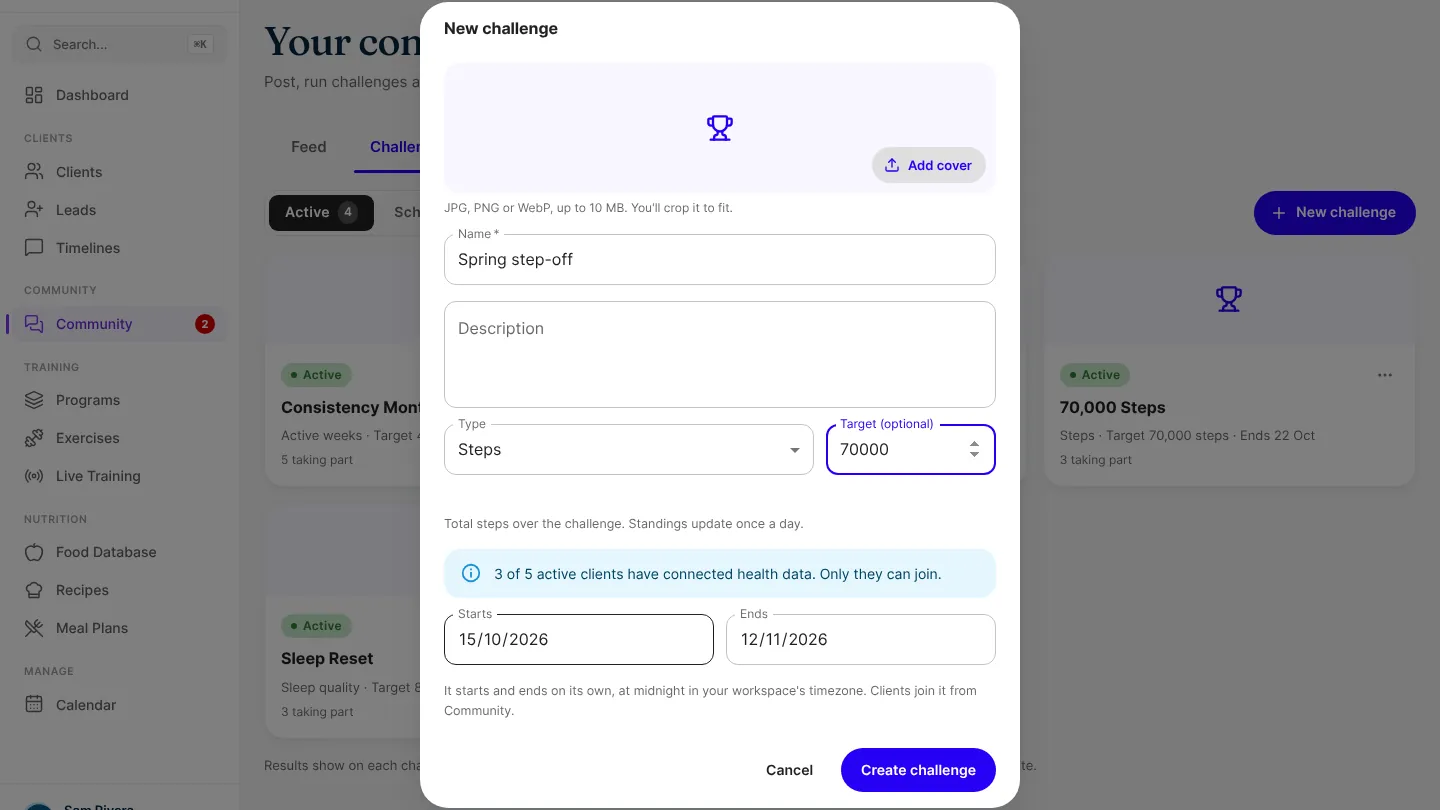
Run a steps, active calories or sleep quality challenge for your clients
Community challenges can now count steps, active calories or sleep quality. Set the dates, and clients who've connected their health data in the app can join.

The Exercises Coaches Are Programming Less (And What Replaced Them)
Nothing was banned. Five once-standard movements sit at the thin end of premium programming now: the crunch, the upright row, behind-the-neck work, good mornings and unstable-surface loading.

The Movements Every Coach Programs, Whatever the Goal
Powerlifting, physique, rehab, CrossFit: the specialties barely resemble each other. Across 70,000 logged workouts, the same five movement patterns sit under all of them.