
The Margin That Isn't All Take-Home: A STEALTH Conditioning Case Study
STEALTH Conditioning ran its real numbers through the FitFocus business audit calculator. The 81 percent net margin is accurate, and it still isn't what lands in the owner's pocket. Here's the honest version.

Nick Hogan runs STEALTH Conditioning, a strength and conditioning practice, and was one of the first coaches on FitFocus. He ran his own figures through the FitFocus business audit calculator, and it returned an 81 percent net margin. That number is correct. Nick does take that profit home every month. It still isn't the whole story of his fitness business profit margin, because the interesting part is what happens to that money next. Most solo operators are looking at the same gap in their own numbers without noticing it.
$15,000 a month, $2,900 in costs, 81 percent margin
This is the unedited output. Revenue, hard costs, and what's left after the bills are paid.
| Line | Amount |
|---|---|
| Monthly revenue | $15,000 |
| Monthly costs | $2,900 |
| Net profit | $12,100 |
| Net margin | 81% |
The $2,900 breaks down into a gym licence and floor fee of $1,250, marketing of $750 that now covers the editor who cuts Nick's videos together, software and tech of $800, payment processing of $50, and insurance of $50. All of it is real spend. What's left after those bills, $12,100, is Nick's to take home. That part isn't in dispute.
Gross profit isn't free cash
Nick does take the $12,100 home every month. What the raw margin doesn't show is that a healthy business can't spend all of it as personal income. Some of it has to go back into the business. Tax and super set-asides. New equipment. Software upgrades. Marketing spend to keep growing. A buffer for a slow month. None of that shows up as a cost on the calculator, because it isn't a bill Nick has to pay this month. It's money he chooses not to spend today so the business is still standing next quarter.
An 81 percent margin describes what's left after the bills. It doesn't describe what's actually free to spend, because staying in business means continuing to invest in it.
So the number worth chasing isn't what's left after the bills. It's what's left after the business has taken its share too. Rather than publish a guess as fact, it helps to set the reinvestment assumption yourself and watch the real figure move.
What's the honest margin?
Pick the share of monthly profit a solo operator should hold back for tax, super, equipment, and growth. The reserve comes out of the $12,100 net profit, and the free cash margin is whatever is left measured against the $15,000 of revenue. Here is how three reasonable assumptions land. The estimates below are independent and have not been confirmed by Nick for his own business.
| Share held back | Monthly reserve | Free cash per month | Free cash margin |
|---|---|---|---|
| 20% (light) | $2,420 | $9,680 | 65% |
| 35% (middle) | $4,235 | $7,865 | 52% |
| 50% (heavy) | $6,050 | $6,050 | 40% |
At the middle assumption, holding back 35 percent leaves a $4,235 monthly reserve and $7,865 of genuinely free cash, a 52 percent margin. That's the version Nick could defend to an accountant, an investor, or himself.
A different, more honest 52 percent
Fifty-two percent is still a strong small business. It's just not 81. Push the assumption to its conservative and generous ends and the honest number still sits somewhere between the low-40s and high-60s, nowhere near what the raw calculator prints by default. That's normal. Most solo coaching businesses look like this once ongoing reinvestment has a real number attached, and it doesn't make the business a bad one. It makes the number a real one.
This is the same trap behind most rules of thumb about a healthy profit margin for a fitness business. The headline percentage looks generous until you subtract the parts nobody bills you for. It's worth reading alongside how much of that margin quietly leaks to tools, which is the subject of what your software should cost as a percentage of revenue. FitFocus passes Stripe's standard processing fees through at cost with no platform markup, which is part of how its one flat plan (a few hundred US dollars a month, billed annually) keeps that leak small and predictable as a practice like STEALTH grows.
Run your own numbers through the same two questions
What does the calculator say your margin is, and what does it look like once ongoing reinvestment has a number attached? Every solo coach and personal trainer running their own book should be able to answer both. Run the free business audit, or book a 30-minute demo to see how FitFocus fits the way you already coach.
The same question, asked per client, is the subject of our guide to which clients are worth keeping at their current price.
Revenue, cost, and profit figures are Nick Hogan's own, entered into the FitFocus business audit calculator. The free cash estimates use an independent reinvestment assumption and have not been confirmed by Nick against his own numbers.

Written by
Nick Hogan and FitFocus
Nick Hogan founded STEALTH Conditioning and was one of the first coaches on FitFocus; the revenue, cost, and profit figures in this piece are his own. FitFocus writes about coaching software, pricing, and the business of running a premium coaching practice, and is part of the Hale Health ecosystem.
Keep reading

Onboarding a New Coach: The First Thirty Days on Your Team
Most coaching businesses onboard a new coach by shadowing and hope. This is the thirty-day plan that replaces it: a standard-led week one, co-delivery, supervised solo work, and the review that keeps quality after independence.
See everything about a contact, and tag and group them
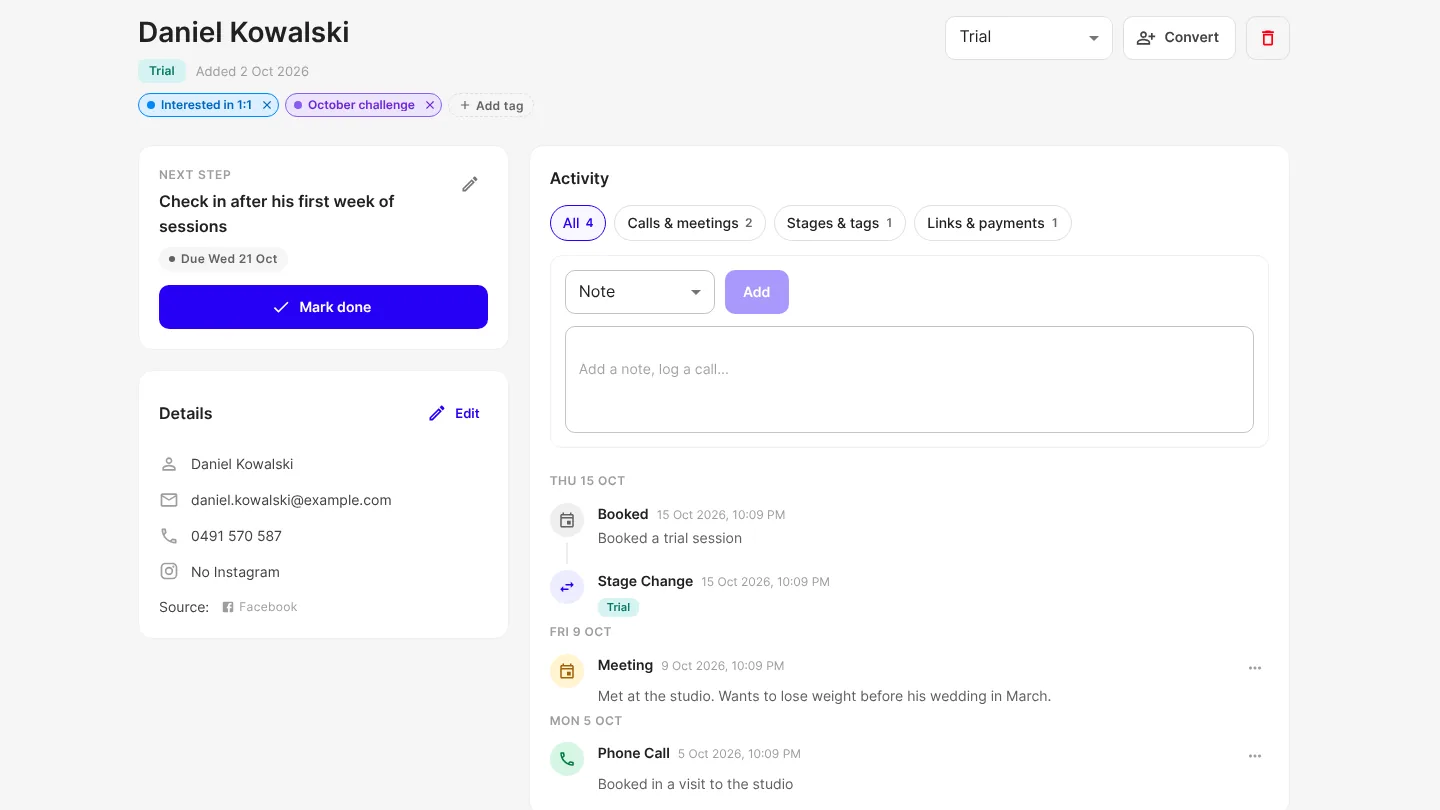
Every lead and client gets one Activity history, and their lead history carries over when they become a client. Tag people, find them by tag and save a group as a segment.

Handing a Client to Another Coach Without Losing Them
A client who signed up for you and is reassigned to someone else is the most delicate moment in a coaching business. The five-stage hand-off, the words that work at each stage, the two transfers to refuse, and the thirty-day check that tells you whether it took.