
Onboarding a New Coach: The First Thirty Days on Your Team
Most coaching businesses onboard a new coach by shadowing and hope. This is the thirty-day plan that replaces it: a standard-led week one, co-delivery, supervised solo work, and the review that keeps quality after independence.

Photo by Vitaly Gariev on Unsplash
Onboarding a new coach usually happens by osmosis. The new hire shadows the owner for a week, watches a few sessions, sits in on some check-ins, and is then handed a roster. It works for the first hire, when the owner is still the standard and there is time to answer every question. It fails at the second, because nobody wrote down what the shadow week was supposed to transfer.
The question this page answers is what the new coach is onboarded into. If the answer is your building, your software and your calendar, the delivery standard stays in your head and the hire becomes a slower version of you. If the answer is a documented standard, enforced by the templates everybody works from, the new coach can reach independence in about a month without guessing at what good looks like.
This page covers the coach joining your team. The hire decision belongs to our guide to when to hire a second coach, and the hand-off that often supplies their first roster belongs to handing a client to another coach. Before any of it, the standard has to exist, and the six documents that make it real are set out in systemising a coaching business.
What a new coach actually needs to know, in order
There are four things to teach, and the order matters more than the content. Most inductions teach them backwards.
The standard comes first. What a good check-in contains, how a program is built, how fast a message gets answered, what happens when a client misses a week. This is the part the business exists to deliver, and it is the part a new coach cannot infer from watching.
The tools come second. Where the program builder lives, where the check-in forms are, where the client record sits, how the team inbox works. A competent coach learns software in an afternoon. Do not spend the first day on it.
The clients come third. Which clients they inherit, which they take fresh, and what each one is working towards. That is a hand-over conversation, not a tour.
Your judgement comes last, and only where it is needed. The exceptions, the clients who need handling differently, the times the standard bends. Save this for week three, when the new coach has enough context to understand why the exception exists.
The order protects the thing that usually gets lost. An induction that opens with the building and the software produces a coach who knows where everything is and nothing about how you work.
How long does it take to onboard a new coach?
Plan for thirty days for a competent coach joining an established standard: one week observing, one week co-delivering, one week solo with review, and one week independent with a quality check. A business without a documented delivery standard takes longer and gets less consistent results.
The thirty days is a shape rather than a promise. A coach with ten years of relevant experience still needs the standard week, because the point is not competence. It is calibration. A newer coach may need a second week of co-delivery, and that is a reasonable trade. What should not stretch is the review. An extra week with somebody reading the work is cheaper than a month of unreviewed delivery.
Week one: teach the new coach your standard, not your building
The first week is reading and watching, in that order. Not the fire exits and the opening checklist. The six documents, then sessions against the standard they describe.
Give the new coach the documents on day one and ask for questions by the end of day two. The questions tell you which document is vague. A document that produces no questions is either perfect or unread, and after a first hire it is usually unread.
Shadowing needs a brief. "Watch how I coach" produces a spectator. "Watch how this check-in follows the format, and note where I deviate and why" produces a coach. Send them into each session with one or two things to look for, then spend fifteen minutes afterwards on what they saw.
By the end of the week, they should produce one piece of work rather than consume more. Ask for a program draft for a client they will not deliver, or a written check-in response to a real week. Review it against the standard and say plainly where it differs. This is the first calibration point, and it is cheaper here than in front of a client.
The platform is what makes the standard visible. When the house method lives in shared program templates and a shared exercise library, the new coach builds inside it from the first draft. Templates belong to the workspace rather than to the person who made them, so every coach opens the same library and clones what they need. The structure carries the standard while the coach is still learning it.
Week two: co-delivery and the new coach's first supervised check-in
Week two moves from watching to doing with somebody present. The new coach runs parts of sessions and writes check-ins while you stay in the room and in the thread.
Start with the check-in, because it is where the standard shows most clearly. A program can look right on paper and still be a poor fit. A check-in reveals whether the coach read the week. Read their draft before it sends and review it on four points:
- Evidence. Did they read the training log and the client's messages, or did they write a generic response?
- Interpretation. Did they say what the week meant, rather than only restating what happened?
- One adjustment. Did they change something, and can they say why?
- Shape. Does it acknowledge the week, interpret it, then adjust the plan, in that order?
The first supervised check-in should be reviewed before it sends, not after. That is not distrust. It is the same reason a new coach's program gets a second read before a client sees it. The review is the teaching, and it is far easier to discuss a draft than to correct a message the client has already read.
Co-delivery also settles the client question. Where a client is transferring in, the incoming coach runs the session while the departing coach stays present, which is the overlap stage in the hand-off sequence. The new coach gets a live client with a known history, and the client gets to watch before they depend on anyone.
Week three: the new coach's solo delivery, with review
Week three is solo delivery with a review gate. The new coach owns a small roster, runs their own sessions and writes their own check-ins, and you read the work before it goes.
Keep the roster small enough that the review is real. A coach with fifteen clients in week three produces more work than one owner can read properly, and a review that becomes a skim is worse than no review because it looks like oversight. The right size is the number of check-ins you can read closely in a sitting, and that is a judgement about your week rather than a number this page can give you.
Two gates matter. Programs are reviewed before they are assigned, so a client never receives a block nobody else has read. Check-ins are reviewed before they send for the first half of the week, then read after they send for the second half. Moving the gate from before to after is the signal that the coach is ready for week four.
The shared record makes this possible without the coach forwarding anything. Programs, logged sessions, check-in responses and notes sit in the client's record, visible to the coaches in the workspace. You are reading the same work the client sees, not a summary assembled for you.
Week four: a new coach's independence, and the quality check that keeps it
Independence in week four does not mean the review stops. It means the review changes from every piece of work to a sample of it.
Name the sample before the week starts: one check-in and one program per coach per week, chosen by you rather than offered by the coach. Review against the same four points from week two. If the sample holds for a month, the coach is independent. If it slips, the sample did its job, and the fix is a conversation rather than a surprise at the quarterly review.
This is the difference between onboarding and quality assurance. Onboarding ends when the coach can deliver the standard without a gate. Quality assurance is the system that keeps sampling after the gate is gone, and the sampling method, cadence and corrective loop are set out in our guide to keeping coaching quality consistent across a team.
Book the thirty-day review before day one. Four questions, asked in a normal one-to-one rather than a performance meeting:
- Which part of the standard is still unclear when you are in the middle of the week?
- Where did you depart from it, and what did you see that made you depart?
- Which client are you least sure about, and what would help?
- What should the next coach be told that these documents do not say?
The last question is the one that improves the business. A new coach sees the gaps an owner stopped noticing years ago, and the answer belongs in the documents rather than in a notebook.
The six documents that make coach onboarding repeatable
The thirty-day plan assumes there is a standard to onboard into. For most coaching businesses that standard is six documents, and the full templates for each are hosted in the guide to systemising a coaching business:
- Intake, so any coach can take a new client to the same standard.
- The onboarding sequence, so the first fortnight of a client relationship does not depend on who runs it.
- The programming standard, so two coaches produce programs a client cannot tell apart.
- The check-in format, so the weekly review reads the same whoever writes it.
- The response-time rule, so message speed is a standard rather than a mood.
- The hand-off procedure, so a client can change coach without the service changing.
The new coach needs the first four in week one. The response-time rule matters from their first day in the inbox, and the hand-off procedure can wait until a transfer involves them. All six should be readable in under an hour, which is the test of whether they will be used.
Where the standard can live inside the platform, put it there. Shared templates carry the programming standard, reusable forms carry the intake and check-in formats, and the team inbox carries the response-time rule into a place everyone works. A document tells a coach what to do. A template makes the right thing the easy thing. The split between the two is covered in the systemisation guide, and the governance that keeps shared templates from drifting once several coaches use them is covered in programming template governance for a team.
What to do when a new coach's standard slips at month three
Month three is when drift shows up. The first month is watched, the second is confident, and the third is where a coach under a full roster starts taking the shortcuts that make the week fit. The slip is normal. The response is what decides whether it stays small.
Diagnose before correcting. Drift has four common causes, and only one of them is about the coach.
- The standard was never clear. The document said what to do but not what good looks like. Fix the document.
- The review stopped. The sampled check-in quietly disappeared from your week. Restart the sample.
- Capacity is squeezing the work. The coach is not cutting corners out of carelessness. Their roster has outgrown the time the standard needs. That is a planning question, and the arithmetic belongs in capacity planning for the business.
- The coach disagrees with the standard. This is the useful one. They have found a better way to do something, or they think the house method is wrong for a client. Listen before you correct.
When the disagreement is real, test it. Ask the coach to run the alternative on one client for a block, with the same review you would give anyone, and compare the result against the standard. If it is better, change the standard and tell the rest of the team why. If it is not, you now have a shared example rather than an instruction. A standard that cannot survive a challenge from the people delivering it is a preference wearing a policy.
What you should not do is treat the slip as a discipline problem before you have checked the four causes. The corrective conversation is about the work, and the framing matters. The aim is the next month's delivery, not a record of the last one.
Frequently asked questions
How long before a new coach takes their own clients?
Week three in the thirty-day plan, with review before the work goes out. Week one is observation, week two is co-delivery, and week three is solo delivery with a gate. If the coach has never run their own roster, add a second week of co-delivery rather than shortening the review.
Should a new coach start with new clients or transferred ones?
Both, for different reasons. A transferred client comes with a record and an existing rhythm, which lets the new coach practise the standard against known history. A new client starts at intake, which tests whether the coach can build the relationship from the front door. Most first rosters mix the two.
How do I review a new coach's quality without micromanaging?
Review everything for two weeks, then move to a named sample. Choose one check-in and one program per coach per week yourself, and review against published criteria rather than your taste. The coach knows what is being sampled and why, the sample is small enough to do properly, and the gate is a development loop rather than surveillance.
What if the new coach works differently to me?
Separate style from standard. Style is delivery: tone, cueing, how a session feels. The standard is the repeatable part: what a check-in covers, how a program is structured, how fast a client hears back. Style belongs to the coach and should be left alone. A departure from the standard is a conversation, and if the departure is an improvement, it belongs in the next version of the standard.
Before the first day, do two things: book the thirty-day review in the calendar, and check that the six documents are short enough to read in an hour. The plan above only works because there is a standard to teach. If the documents are not ready, the honest move is to spend the fortnight writing them, which is the argument in systemising a coaching business, and to delay the start date rather than run an induction that teaches the new coach to guess. The hire itself, and the numbers that decide whether it pays, stay in when to hire a second coach, and the operating rhythm the new coach joins after month one is covered in the operating system for a coaching business. For the team workspace all of it runs in, see gym owners running a coaching team.
No operator interviews are quoted on this page. The thirty-day plan and the review rhythm are the FitFocus team's reconstruction from published coaching practice and our own platform-data reports, offered as patterns to adapt to your own business rather than findings to cite. Names in examples are placeholders. This article is a guide for your own decisions, not employment or legal advice.

Written by
FitFocus team
FitFocus writes about coaching software, pricing, and the business of running a premium coaching practice. FitFocus is part of the Hale Health ecosystem.
Keep reading
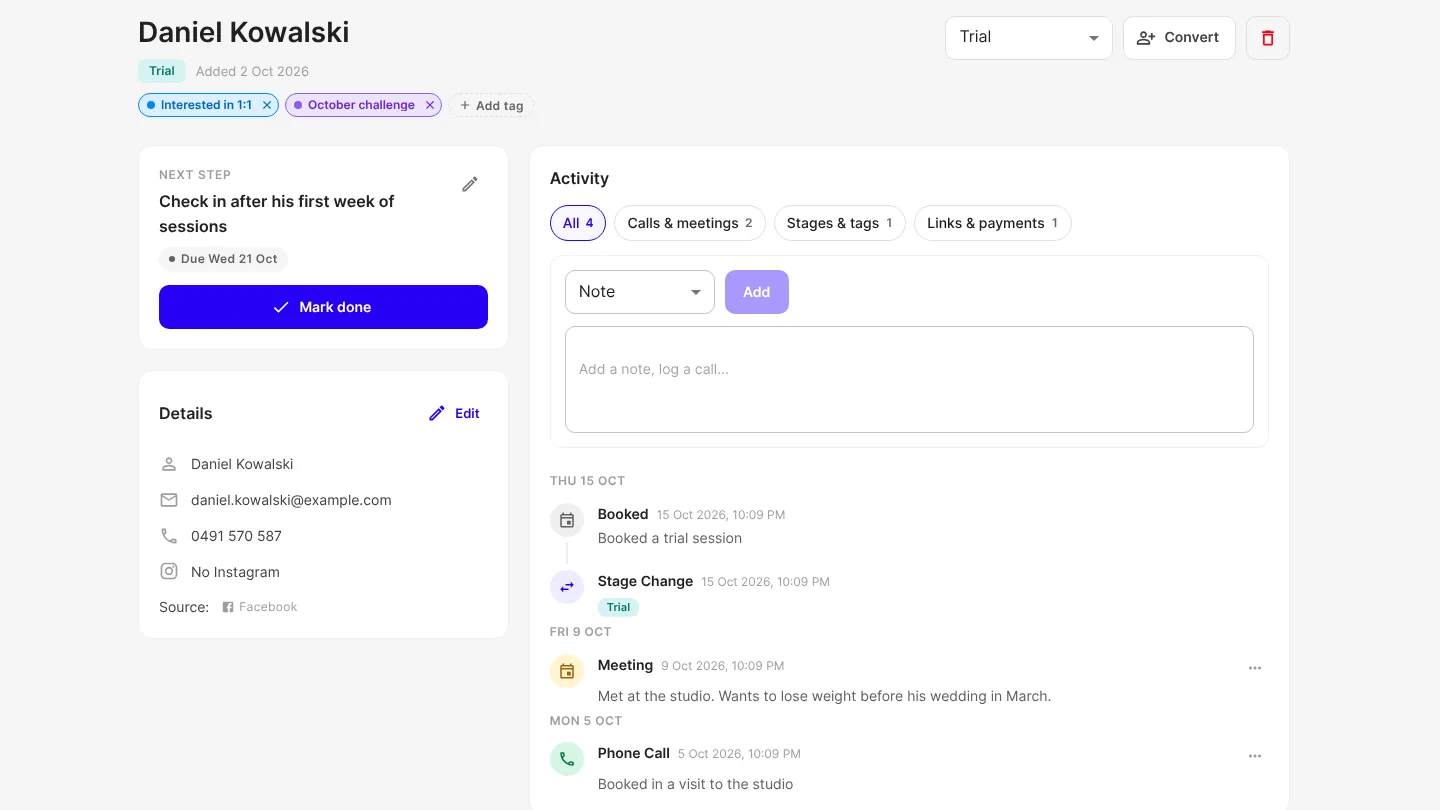
See everything about a contact, and tag and group them
Every lead and client gets one Activity history, and their lead history carries over when they become a client. Tag people, find them by tag and save a group as a segment.

Handing a Client to Another Coach Without Losing Them
A client who signed up for you and is reassigned to someone else is the most delicate moment in a coaching business. The five-stage hand-off, the words that work at each stage, the two transfers to refuse, and the thirty-day check that tells you whether it took.
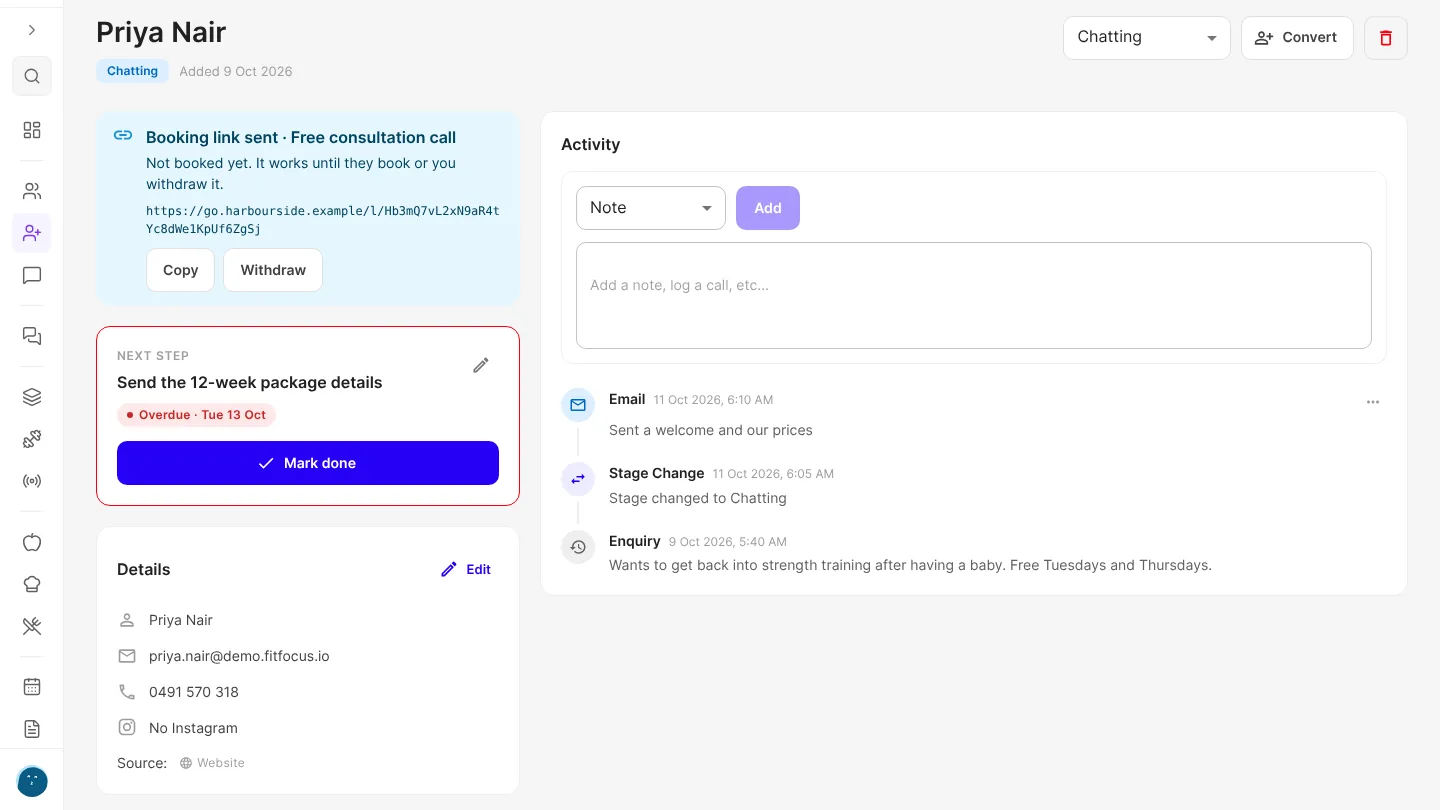
Get enquiries straight into Leads, and never miss a follow-up
Share one enquiry link or add a form to your website, and every enquiry lands in Leads with where it came from. Each lead gets a next step, a due date and a reminder.