The Exercises That Travel Together: What Coaches Pair
Coaches do not pick exercises one at a time, they pick them in pairs. Across 70,000 logged workouts, the same couplings keep turning up, and two rules sit behind almost all of them.

Author
FitFocus writes about coaching software, pricing, and the business of running a premium coaching practice. FitFocus is part of the Hale Health ecosystem.

Coaches do not pick exercises one at a time, they pick them in pairs. Across 70,000 logged workouts, the same couplings keep turning up, and two rules sit behind almost all of them.

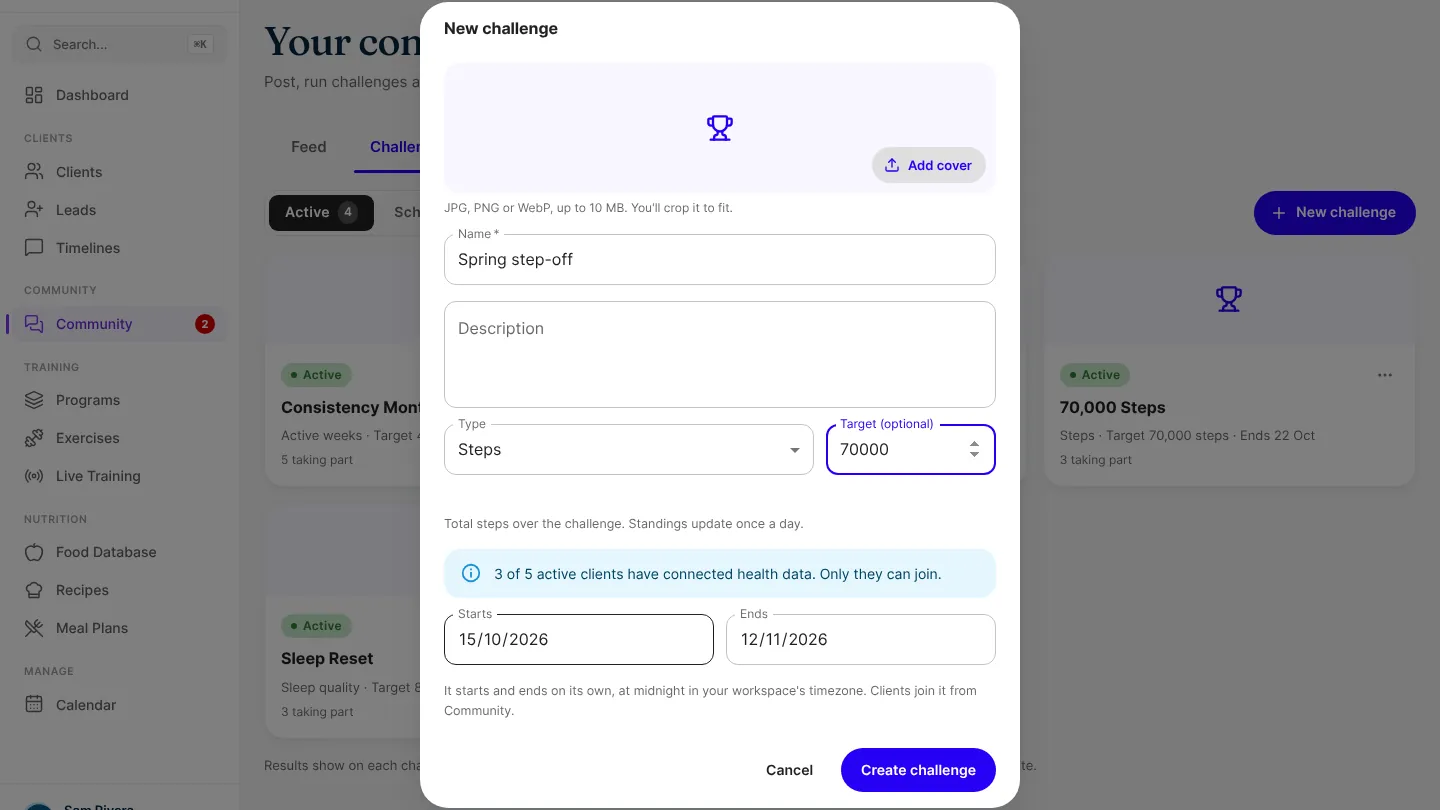
Community challenges can now count steps, active calories or sleep quality. Set the dates, and clients who've connected their health data in the app can join.

Nothing was banned. Five once-standard movements sit at the thin end of premium programming now: the crunch, the upright row, behind-the-neck work, good mornings and unstable-surface loading.

Powerlifting, physique, rehab, CrossFit: the specialties barely resemble each other. Across 70,000 logged workouts, the same five movement patterns sit under all of them.

Warm-up, mobility and activation work is close to one in ten programmed movements, and nearly four in ten practices build a prep block. What 70,000 workouts show about the work before the first set.

When a client finishes a workout, FitFocus turns it into a card in your brand that they can post to one of their groups or to your community, or share to any other app.

Hamstring curls, leg extensions and hip work turn up in almost every coaching program. Across 70,000 logged workouts, here is what that consistency says.

Preparation before load, and load earned rather than scheduled. Across 70,000 logged workouts, the clinical corner of coaching is the one the rest are quietly borrowing from.

FitFocus now shows fibre for every item, meal and day in your meal plans and recipes, and each client can track a daily fibre target you set.

Clients who log a workout late can now set the day and time they actually trained, so their streak, your dashboard and your weekly numbers show the real day.

Strength, speed, power and conditioning, periodised into one plan. Across 70,000 logged workouts, hybrid is coaching's least specialised archetype, and the one the rest are converging on.

Keep follow-ups, reminders and ideas on the FitFocus dashboard. Each note is private to you, or shared with every coach in your organisation, and ticked off when it's done.

Weightlifting, gymnastics and conditioning, scored every time. Across 70,000 logged workouts, CrossFit is the archetype that refuses to specialise, and four of its moves travel to any roster.

Two lifts and a mountain of derivatives. Across 70,000 logged workouts, Olympic weightlifting is coaching's most repetitive programming, and four of its moves travel to any roster.

Machine country. Across 70,000 logged workouts, physique is the biggest style in coaching, built one muscle at a time, and four of its moves travel to any roster.

A private feed for your clients, run by you, inside the app they already use. Post to your whole client base, run challenges scored from training, and moderate it all from Reports.

Three lifts, one scoreboard. Across 70,000 logged workouts, powerlifting is the most concentrated programming in coaching, and four of its moves travel to any roster.

Structured cardio is roughly 2% of what coaches program. The conditioning did not disappear. It moved into the daily step target, where the training log cannot see it.

Coaches run their week on their own calendar. Their clients run on a different one. Across 70,000 logged workouts, the training week has a clear shape.

The barbell-versus-machine debate, settled with data. Across 70,000+ logged workouts, machine and cable isolation leads premium physique programming.

A standard too rigid breaks individualised coaching; one too loose breaks the brand. Programming governance for a team: the change rule, the version flow to clients, and the deviation rule that bounds personalisation.

Delegation in a coaching team feels dangerous because context lives in heads. The single client record: seven things it contains, the three rules that keep it current, and why it is the safety system under every hand-off.

Most multi-service coaching businesses carry a tier nobody would design on purpose. The scheduled tier review: contribution per delivery hour, the keep, redesign and sunset rules, and a verdict recorded per tier.

The platform decision is made; the migration is the project that can still lose a month. Four phases, readiness to first-week review, what transfers and what does not, and the fragile first weeks handled deliberately.

C1 wrote the standard down. Quality assurance is the monitoring system that keeps it alive: three sampling methods with time costs, a cadence shaped by the span budget, and a corrective loop with three exits.

Every cancellation opens a delivery slot that sits empty while the refill takes, and the refill itself costs coach hours. The slot-churn model, a worked example, and what a churn spike actually does to deliverable capacity.

In a coaching team, the enquiry ends in one person's hands and delivery starts in another's. The seven-stage handoff, one owner per stage, what transfers when a lead becomes a client, and the two scripts that remove the memory gap.

The revenue forecast asks what next year earns. The capacity forecast asks whether it is deliverable: coach hours, utilisation, the slots churn opens and closes, and the three-scenario range that makes the gap visible months early.

Studio scorecards measure class fill because studios run classes. The coach scorecard for a 1:1 or hybrid team: tenure trend, response time, completion, feedback, and the revenue metrics defined once and linked, not restated.

The default answer to admin overload is headcount. The substitution model prices the removable hours at their true cost and sets that against the flat price of the tooling, and the honest version sometimes concludes: hire.

Span of control in a coaching business is a budget of hours, not a count of coaches. The supervision-load model, worked at three roster sizes, and the thresholds that fall out of it.

At team scale, check-ins drift: cadence varies, review depth varies, escalation is undefined. The five-part team check-in system, with the review-load arithmetic that keeps it inside the hours a business actually has.

Most coaching businesses price each service in isolation. One margin model, run across 1:1, hybrid, group and digital delivery, shows what each tier earns per coach hour and where the break-evens sit.

A coaching business with a team and no operating rhythm still runs through the owner's head. Here is the weekly cadence that fixes it: the number review, the team meeting, the quality sample, the escalation rules and the reviews that keep them honest.

The hardest transition in a coaching business is not the hire; it is the identity change from being the product to running the delivery system. Four stages, a test for each, and what you give up to move through them.

Coaching businesses plan for clients, never for delivery. The four-variable model that turns coach hours, utilisation, service design and price into a forward-looking capacity plan, and the gap that decides your next hire, price or service change.

Most coaching businesses cannot say how many enquiries became clients last month. Count the four numbers, find the drop-off, and fix the process before spending anything on marketing.

The platform is the constraint when it charges per client as you grow, cannot give multiple coaches shared access, or cannot carry your brand. Six platform symptoms and four process problems, side by side.

Almost everything written about price rises covers the conversation. This is the arithmetic: the break-even churn calculation that decides whether a rise is worth doing, and how many of your roster you can afford to lose.

Total revenue stops being useful at two coaches. Revenue per coach and utilisation are the numbers that expose whether a team is genuinely growing, or just spreading the same roster across more people.

Every article about coaching automation is written by somebody selling automation. Here is the other side: a two-question test, four quadrants, and twelve coaching touchpoints sorted into them.

Coaches are told their admin is out of control, then handed nothing to measure it with. Here is a two-week admin audit in five categories that turns your hours into a minutes-per-client number, the figure that decides what to fix first.

Every article about coach pay is written for the coach. This one is for the owner: four pay structures modelled to the residual margin, with the break-points where each one stops working.

A coaching business on monthly billing is a subscription business, and subscription businesses are forecastable. Here's the four-input model, the twelve-month view, and why a small roster needs a range, not a number.

The rule of thumb says hire at eighty percent of capacity. The arithmetic is better. Here's when a second coach stops costing you money, and how many clients it takes.

The per-client picture is different from your business margin, and almost nobody looks at it. Here's how to calculate the cost to serve a coaching client, why it can be negative, and what to do about it.

Documenting a coaching business means writing down what somebody else will deliver, in hand-over order. Here are the six documents, each with a template, and the ordering that makes systemisation survive contact with another coach.

The long KPI lists are generic and none of them changes what you do next month. Here are the six coaching business metrics that run the business, the decision each one triggers, and the ones that look important and are not.

Ask a coaching business owner whether the business could run without them for two weeks and the honest answer is almost always no. Here is the ten-point diagnostic that shows what breaks first, and what each one needs.

Coaching businesses hit two ceilings. The first is the coach. The second is the business, and it cannot be marketed past. What each one looks like, and the only four ways out of the second.

Most coaches focus on acquiring new clients. The maths of retention tells a different story. What holding a client for one additional month is actually worth, and how it compounds.

The benchmark is 1 to 6 percent of revenue, depending on your model. The harder question is whether you can actually calculate what you pay, because most pricing is built to make that difficult.

Revenue tells you how busy you are. Margin tells you whether the business works. What a healthy fitness business profit margin looks like, what drives it, and how to check yours.

Most gym software is built for class-led studios. Most coaching software is built for solo coaches. Here's what a coaching-led studio actually needs, and where the market gaps are.

What FitFocus, Trainerize, Everfit, TrueCoach, My PT Hub and PT Distinction each list for a branded client app, from their own sites. Checked 14 October 2026.

What Trainerize Studio Plus lists, and what FitFocus, My PT Hub, TrueCoach and PT Distinction list instead, from their own sites. Checked 14 October 2026.

What FitFocus, Trainerize, My PT Hub, PT Distinction and Everfit each list for teams and pricing, from their own sites. Checked 14 October 2026.

How FitFocus, Trainerize, TrueCoach, My PT Hub and Everfit each price as your roster grows, from their own sites. Checked 14 October 2026.

The words each coaching platform uses for a branded client app, quoted from its own site, and the questions to ask before you pay. Checked 14 October 2026.

What FitFocus, TrueCoach, My PT Hub, Trainerize and PT Distinction each list for branded apps and pricing, from their own sites. Checked 14 October 2026.