
Handing a Client to Another Coach Without Losing Them
A client who signed up for you and is reassigned to someone else is the most delicate moment in a coaching business. The five-stage hand-off, the words that work at each stage, the two transfers to refuse, and the thirty-day check that tells you whether it took.

Photo by Vitaly Gariev on Unsplash
The hire was the decision. The hand-off is the work. Transferring a client to another coach is the moment a coaching business finds out whether it sold a relationship with a person or a service with a standard, and most owners learn the answer about four days after they tell the client. Handled well, nobody notices anything except that the programme kept arriving. Handled badly, you lose a client you already paid to acquire, and you hand your new coach a first month of damage control.
This page is the procedure rather than the argument. Whether to make the hire at all belongs to our guide to when to hire a second coach, and how many clients can actually move belongs to the arithmetic in capacity planning for a coaching business. From here, the hire is made, a coach is on the roster, and a named client has to change hands this month.
How do you transfer a coaching client to another coach?
Transfer in stages rather than at once. Tell the client early with a reason that is about their service, introduce the new coach while you are still involved, run two sessions together, then hand over fully and check in personally at thirty days. Abrupt reassignment is the usual avoidable cause.
Everything below expands that sentence. The order matters more than the pace. A hurried version of the right sequence still works, and a leisurely version of the wrong one still fails.
Will clients leave if I hand them to another coach?
Some will, and the rate depends on framing and pacing rather than on the new coach's ability. Clients told late, given a commercial reason, or moved without an overlap leave most often. Clients who meet the new coach while the original is still present rarely do. No rate is offered here.
That answer is awkward for anyone selling software, because it concedes the thing the category prefers to leave unsaid: clients are loyal to people first. A hand-off designed as a data problem will be designed badly, and the client will feel the seams. The workable position sits between the two extremes. A relationship cannot be moved; a service can. What genuinely transfers is the delivery standard, the record, and the rhythm the client has come to expect, and if the incoming coach holds all three from the first week, the loyalty has somewhere to land.
Why hand-offs fail, and it is almost never the new coach
When a transfer goes sideways, the owner's first instinct is to blame the coach who inherited the client. Trace it back and the new coach is usually the third thing that went wrong.
The client was told late. Owners put the conversation off for weeks, because the news feels like a demotion to deliver. By the time it arrives, the client has been working with a coach who knew and said nothing, and the announcement lands as something decided about them rather than with them.
The reason given was commercial. "I'm getting busier." "I'm stepping back from one-to-one." "We're restructuring the roster." Every one of those is true, and every one of them tells the client the change is about the business's convenience. They hear that they are an operational item on someone's list.
The overlap was skipped. The overlap is the one stage where two coaches are paid for a single client, so it is the first thing cut when a hand-off is rushed. It is also the only stage where the client watches the new coach work before becoming dependent on them.
All three are decisions the owner makes before the new coach does anything, which is the useful part: they sit inside your control and cost nothing but a calendar.
The clients you should not transfer
The sequence below is not for every client, and two situations deserve a straight no.
Not now: a client in an acute stretch. A client three weeks into a return-to-training plan, or eight weeks out from a dated event they have trained all year for, has almost no tolerance for a change of voice. The transfer will still be the right call in a month. Wait for the block to close and move them at a natural boundary. If no boundary exists in the next eight weeks, that is a capacity problem wearing a hand-off costume, and it belongs in the capacity plan rather than in a calendar invite.
Not at all: the hand-off that is really an exit. Sometimes a transfer gets proposed because the business wants a difficult client off a senior coach's roster, or because an objection from the sales conversation was never resolved. Dressing that up as a hand-off makes the client somebody else's problem, and clients pick up on it faster than owners expect. If the client should not be in the business, end the arrangement properly and say so. If you have not delivered what you sold, keep them and fix the delivery. A hand-off is for clients you want to keep and cannot serve well at current capacity, which is a narrow category and a good one to stay honest about.
The five-stage hand-off: transferring a client to another coach, week by week
The sequence below assumes a four-week overlap. A client of two years with a deep history may need six. A client of six weeks may need two. The stages do not change with the length of the overlap; only the weeks stretch.
| Stage | Who leads | What the client sees |
|---|---|---|
| 1. Overlap | Owner or manager | Nothing yet. Dates, capacity and the record read happen before anyone is told. |
| 2. Introduce | Departing coach | A reason that is about their service, a date, and the name of the person taking over. |
| 3. Co-deliver | Incoming coach, with the departing coach present | Two sessions run by the new coach while the old one is still in the room and the thread. |
| 4. Transfer | Incoming coach | One named day when the new coach becomes the first responder. |
| 5. Follow up | Departing coach | A personal check-in on day thirty, and then a step back. |
Stage one: set up the overlap before anyone is told
Three things get decided and written down while the client still knows nothing. First, the dates: the day the client is told, the day the new coach takes their first session, the day the old coach stops being the first responder. Second, the record: the incoming coach reads the whole history before the first conversation, not after it. Third, the note: the departing coach writes down what a record cannot hold, which has its own section further on.
Decide the overlap length on tenure and context rather than on a default. A client of two years needs the longer version, because the incoming coach has more to learn and the client has more to lose. A client who joined six weeks ago and has met the business more than the individual can move faster.
Stage two: tell, then introduce
The news comes from the person the client trusts, in their own words, before anybody else touches the account. Not a system notification, not a calendar change, not a new name appearing in the app.
Four elements make the introduction work: the reason, the date, the overlap, and the first concrete thing the new coach will do. Leave any of them out and the client fills the gap with the least flattering explanation available.
Stage three: co-deliver for two sessions
This is where the client's confidence moves, and it moves by watching rather than by being told. The incoming coach runs the sessions and the check-in. The departing coach is present, quiet, in the room and in the message thread. Both coaches and the client share one conversation, which is the mechanic that makes co-delivery real instead of aspirational.
Two sessions is enough for most clients. The first proves the new coach can run the plan. The second proves the plan responds to how the client is actually going, which is the part a hand-over document cannot demonstrate.
Stage four: name the transfer day and hold it
The transfer day is when the new coach becomes the first responder. After it, the client's messages are answered by the new coach, the programme is changed by the new coach, and the old coach stops replying first out of habit.
The habitual reply is the most common way a well-planned hand-off quietly fails. The old coach sees a message, knows the answer, and sends it in ten seconds. Helpful in the moment, and it resets the client's default back a week every time. If the departing coach wants to answer, they can leave it for the new coach and add a sentence after.
Stage five: the thirty-day follow-up
Thirty days after the transfer day, the departing coach sends one personal message and then steps back for good. Not a check-in disguised as a service review, and not a permanent open door. A named moment that closes the loop, followed by telling the client plainly who to go to from now on.
The departing coach's message, adapted to your own voice:
"Hi Priya, checking in as promised now that you've had a month with Dan. How's the new block landing, and is there anything you'd tell me that you wouldn't tell him? He's your coach from here, so I'd rather hear it from you than guess at it."
What comes next matters as much as the message. If the client raises something, the departing coach passes it to the new coach rather than fixing it themselves. Fixing it feels generous and undoes the month of work.
What to say, and what never to say
The wording carries more weight than the sequence, because the sequence is invisible to the client and the words are not. Four sentences do most of the damage.
| What not to say | What the client hears | What to say instead |
|---|---|---|
| "You'll be working with Sarah now." | An announcement. Something was decided and they are the last to know. | "From the second of November, Sarah runs your sessions. Let me tell you why that is good news for you, and what stays exactly the same." |
| "I'm getting too busy to keep coaching you." | The business's convenience, delivered as the client's problem. | "You've outgrown the weekly slot I can give you. Sarah has two hours a week for your block, and I don't." |
| "Sarah's brilliant, you'll love her." | Borrowed enthusiasm. There is no reason to believe it yet. | "Sarah takes your Thursday session while I'm still in the thread. Judge her after two weeks, not after this message." |
| "Nothing will change, I promise." | A promise the business will break at the first capacity pinch. | "Three things change and three things don't. Here they are, in writing." |
Two scripts cover the rest. The introduction, sent by the departing coach, names the reason, the date and the overlap:
"Priya, I want to give you a heads-up before anything changes. Your block has outgrown what I can give you in one weekly slot, so from the second of November Dan takes over your programming and your check-ins. He's taking your Thursday session this week while I'm still in the thread, and I'll stay in it until the end of the month. Nothing about your plan or your price changes on that date."
And the hand-over note itself, which the departing coach writes while still involved rather than after stepping back. Six prompts, answered in plain sentences, one page total:
- What this client is training for, and by when.
- The two things they are sensitive about, and how it shows up when they are.
- What they have asked for and been talked out of, plus the reason you gave.
- How they prefer feedback, and what they do with it when they get it.
- The last time something went wrong in their plan, and how it was handled.
- What you would do next if you were staying another eight weeks.
The last prompt carries the most and gets written least. It turns a coach's judgement into something the new coach can argue with, which is what an incoming coach needs on day one.
What has to travel with the client, and what cannot
Three things change hands in a good transfer: the record, the thread, and the context. They travel by different routes, and conflating them is where owners get into trouble.
The record stays where it is. Programme history, logged sessions, check-in responses, notes and measurements belong to the client, not to the coach, so in a workspace where the client record is the business's, none of it moves. Nothing is exported and nothing is re-keyed. The transfer is a change of access, not a copy, and the practical test is whether the incoming coach can read three years of history on the morning the client is told. If they cannot, the record was never really the business's.
The thread has to be granted. A message history is different, because it is visible to the people who are in it. The incoming coach has to be added to the client's conversation to read what has been said, and the departing coach can stay in that same thread for as long as the overlap lasts. This is what makes co-delivery real rather than a promise: the client, the outgoing coach and the incoming coach sit in one place from the introduction onwards, which is what the shared team inbox is for. Grant it from stage two, not stage four, or the client is watching a relay race instead of a hand-over.
The context travels by hand. The note in the previous section is the only genuinely manual part of the transfer, and it is the part clients feel first. Everything a coach knows that never made it into a record, the tone, the running joke, the exercise they will agree to on a bad week and the one they will not, has to be said out loud by someone who was there. No system captures that, and none should pretend to.
The thirty-day check: how to tell the transfer took
Read this at thirty days after the transfer day, not thirty days after the introduction. By then one thing should be true: the client's default is the new coach. Five signals tell you whether it is.
- The client messages the new coach first. A question about a session lands in the new coach's thread, not the departing coach's.
- The check-in comes back on the usual cadence. Same day of the week, same turnaround, no drift in either direction.
- The programme has changed at least once. If the plan the previous coach wrote is still running untouched a month later, the new coach has not started working.
- The client raises something small. A niggle, a question, a scheduling change. Quiet is not contentment. It is usually a client deciding not to bother.
- Nobody has been asked to arbitrate. The moment a client asks the old coach to overrule the new one, the transfer has not happened, whatever the calendar says.
Two of the five failing is a pattern rather than a blip. One is worth a nudge. None of them is a rate, and this page deliberately offers no benchmark, because these are reads on a single relationship rather than a number to compare businesses against.
If a transfer does not take, run the sequence again rather than patching around it. Put both coaches back in the thread, run two more sessions together, and name a new transfer date. If it fails twice with the same client, the honest reading is that they bought a person rather than a business, and the options are the ones in the previous section.
The transfer is also what turns a hire into capacity. The ceiling that prompted it sits in our guide to the coaching business growth ceiling, the delivery standard that makes a hand-off repeatable belongs to systemising a coaching business, and the levers that shape how long a client stays, which this page does not touch, belong to the retention economics of online coaching.
Frequently asked questions
How much notice should I give a client before transferring them?
As much as the overlap allows, and never less than whatever notice period their agreement provides for. Practically, the client hears it from their coach before the new coach's first session is booked, with a date attached, so the conversation is about a plan rather than a rumour. Two weeks is a workable floor for a client with no acute block running; longer tenure earns longer notice.
Should I discount during the hand-off?
No. A discount tells the client the service they are now getting is worth less, which is the opposite of what a transfer needs to signal. If you want to give something, give the overlap instead: extra contact from both coaches for a few weeks costs the business time rather than price, and it is the thing the client actually benefits from.
What if the client asks to stay with me?
Pick your answer before the conversation, because it will come up. Either keep them and be straight about the capacity that makes it possible, or run the full overlap and reset the expectation at the end, or, where the arrangement they bought genuinely cannot be delivered any more, let them go cleanly and help them land somewhere good. What you must not do is agree to keep them and then quietly carry the client while the new coach waits.
What if the new coach is not working out?
Separate the two problems. If the client's default is still the departing coach, the fix is stages three and four run properly, not a different coach. If the client is genuinely engaging with the new coach and the sessions are not landing, that is a coaching quality question, and it belongs in the review cadence the business already runs rather than in this procedure.
No operator interviews are quoted on this page, and no figure in it is a benchmark. The sequence, the scripts and the thirty-day signals are the FitFocus team's reconstruction from published coaching practice and our own platform-data reports, offered as patterns to adapt to your own business rather than findings to cite. Names in the sample messages are placeholders. This article is a guide for your own decisions, not business, legal or financial advice.

Written by
FitFocus team
FitFocus writes about coaching software, pricing, and the business of running a premium coaching practice. FitFocus is part of the Hale Health ecosystem.
Keep reading
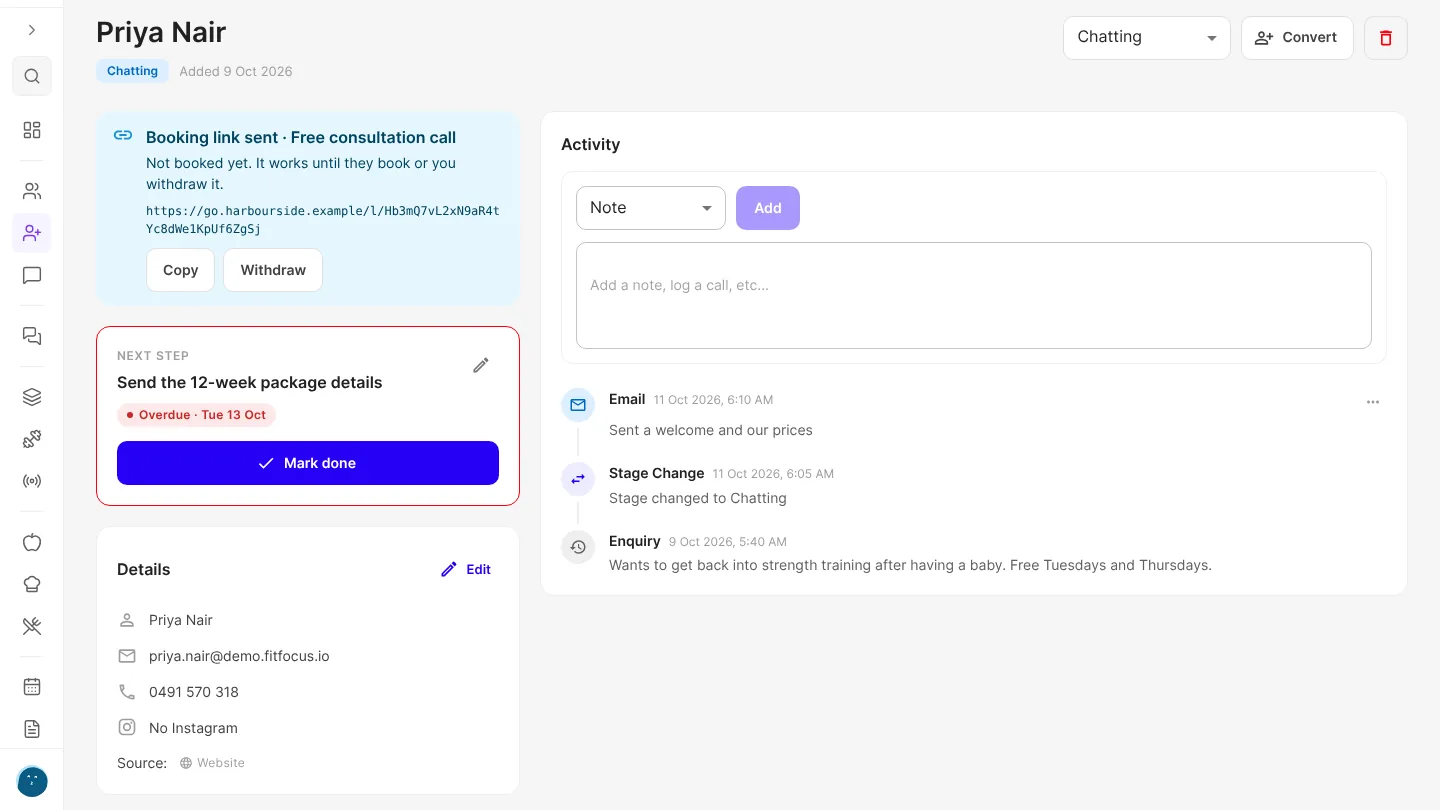
Get enquiries straight into Leads, and never miss a follow-up
Share one enquiry link or add a form to your website, and every enquiry lands in Leads with where it came from. Each lead gets a next step, a due date and a reminder.

The Exercises That Travel Together: What Coaches Pair
Coaches do not pick exercises one at a time, they pick them in pairs. Across 70,000 logged workouts, the same couplings keep turning up, and two rules sit behind almost all of them.
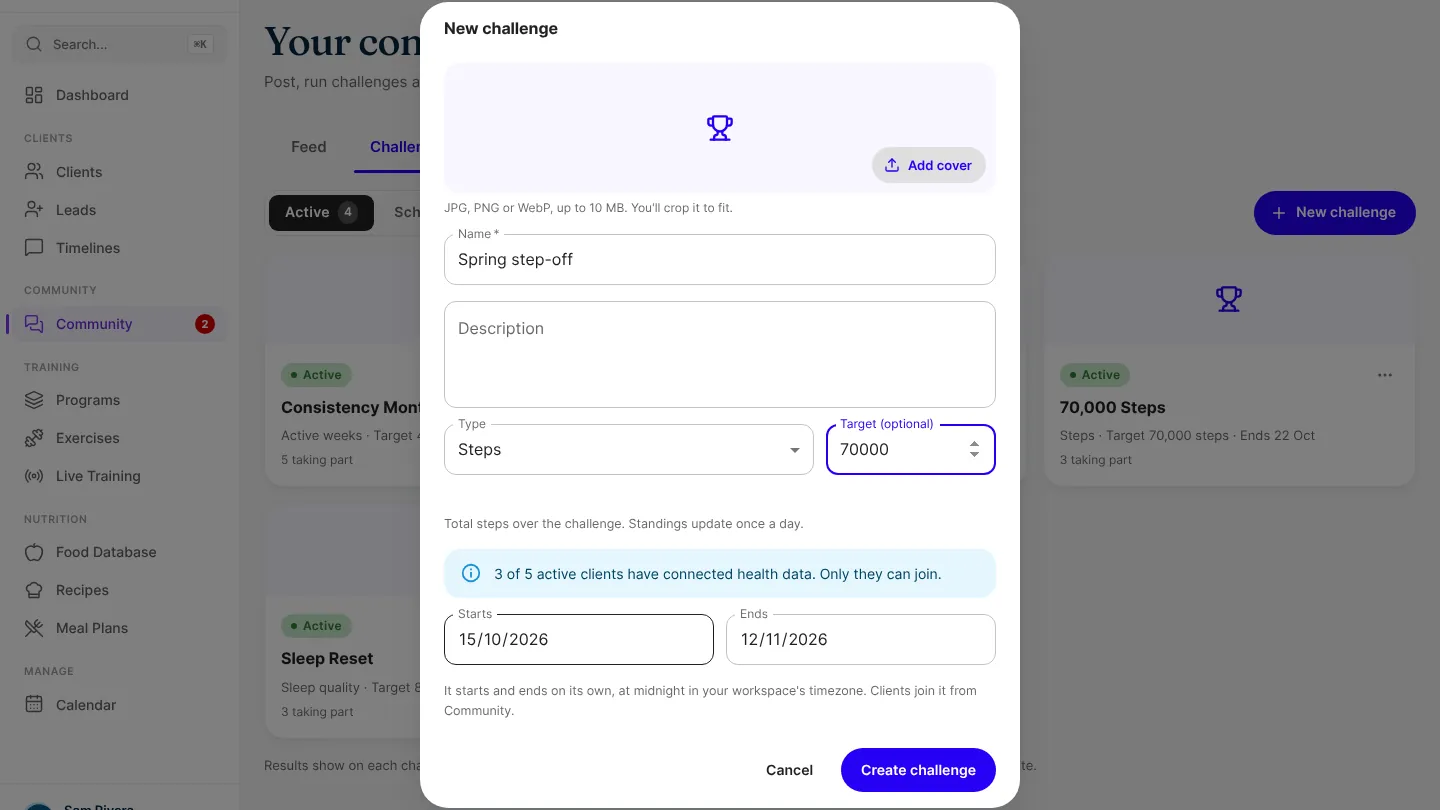
Run a steps, active calories or sleep quality challenge for your clients
Community challenges can now count steps, active calories or sleep quality. Set the dates, and clients who've connected their health data in the app can join.