
The Exercises That Travel Together: What Coaches Pair
Coaches do not pick exercises one at a time, they pick them in pairs. Across 70,000 logged workouts, the same couplings keep turning up, and two rules sit behind almost all of them.
Photo by Samuel Girven on Unsplash
Coaches do not pick exercises one at a time. They pick them in pairs. Look across premium programs and the same exercise pairings keep turning up: a press with a row, a leg extension with a leg curl, a hinge with a leg curl. The couplings are far more consistent than the individual movement choices around them, which is why a good program reads as a set of matched pairs rather than a list.
For this report we looked at approximately 70,000 workouts logged on FitFocus between 2023 and 2026, and at which movements tend to appear in the same programs. The figures describe programming patterns, not individuals, and no client-identifying information is included. This is program-level co-occurrence, so it records what coaches include together in a program rather than what they run back to back in a session.
One boundary is worth stating up front. What follows is a description of what coaches pair, not a program-design guide and not an argument for supersets. Which movements a given client should train, and in what order, are coaching decisions this data does not make for anyone.
What exercises do coaches pair together?
Coaches most often pair opposites and same-muscle stacks. Opposites: a press with a row, a quad move with a hamstring move, a vertical pull with a horizontal row. Same-muscle stacks: a big compound with an isolation for the muscle you want to grow, such as a hinge with a leg curl.
| Pairing | What the data shows | Which rule |
|---|---|---|
| A press and a row | The tightest pairing in the data. Every practice that programs a row also programs a press. | Balance the opposites |
| A leg extension and a leg curl | Almost every practice that isolates the quads also isolates the hamstrings. | Balance the opposites |
| A vertical pull and a horizontal row | Nearly every practice that programs a lat pulldown also programs a row. | Balance the opposites |
| A side raise and a rear-delt fly | When a coach isolates the side delt, the rear delt usually comes with it. | Balance the opposites |
| The adductor and the abductor | These almost always appear as a set, the two sides of the same machine bank. | Balance the opposites |
| A hinge and a leg curl | A Romanian deadlift with a leg curl: the hamstrings as movers first, then in isolation. | Stack the same muscle |
| A squat pattern and a leg extension | A compound to load the quads and an isolation to finish them. | Stack the same muscle |
Seven pairings, and only two ideas behind them. That is the whole finding, and it is why the couplings survive across practices that otherwise agree on very little.
The two rules behind almost every pairing
Read the table closely and the pairings stop looking like a list of habits. Each one is an application of one of two rules.
Balance the opposites
For most muscles a coach trains, they train the opposing side as well. Push comes with pull. Quads come with hamstrings. One pull angle comes with the other. The reason is not symmetry for its own sake. A body that only pushes, or only trains the front of the leg, gets lopsided, and a lopsided body is where overuse problems start. Balancing the pair is the cheapest insurance in the program.
Stack the same muscle
The second rule runs the other way. When a coach wants more of a muscle, they stack it instead of balancing it: a big compound plus an isolation for the same tissue. A hinge and a leg curl for the hamstrings. A squat pattern and a leg extension for the quads. The compound supplies the load, the isolation adds volume exactly where it is wanted, and the pair covers the muscle across the range it actually works through.
Those two rules also explain the shape of the pairs. Balance pairs sit at opposite ends of a joint's work, which is why they read as push and pull or quad and hamstring. Stacking pairs sit at the same end, which is why they read as one movement finishing what the other started.
Why coaches program in pairs
The two rules pay off in different ways, and both of them show up in what the programs look like. Balance pairs keep the body even, which is the quiet backbone of staying injury-free. Stacking pairs put focused volume onto a muscle a client wants to bring up, which is what drives growth. Between them they are the reason a well-built program reads as a set of matched pairs. It is the same balance instinct behind the movements every coach programs, where a handful of patterns survives every specialty change.
The efficiency bonus, and what the research says
There is a practical bonus hiding in the balance pairs. Opposing muscles recover while the other works, so a push and a pull can be run back to back and save time without giving anything up. The Robbins review of agonist-antagonist paired set training set out the idea, and a 2025 meta-analysis of supersets against traditional training put numbers on it: supersets trimmed session time by roughly 37% while total reps and volume load held, with no significant differences in strength or hypertrophy in the studies that measured them. The cost was perceived effort. The sessions felt harder. A separate review of time-efficient training design reaches the same conclusion about the trade.
Worth keeping in proportion. That literature is about organising a session, and the pairing data in this report is about what goes into a program. The two overlap, because a coach who already balances push against pull has the raw material for an efficient session, but they are not the same claim.
What the pairing pattern means for coaching practice
The finding is descriptive. It says nothing about how any individual client should train, but four things follow from it for the person writing programs.
- Audit in pairs, not exercises. Every push has a pull, every quad movement has a hamstring movement. A missing pair is where an imbalance builds quietly, and a missing pair is far easier to spot on a short list of couplings than in a long list of exercises.
- A compound with an isolation is how a lagging muscle gets brought up. A hinge plus a leg curl covers the hamstrings better than either does alone, and it stacks with the posterior-chain work most clients already need.
- The machine pairs arrive as sets. Adductor and abductor, side delt and rear delt. Programming one without the other leaves a gap, and both halves are usually sitting in the same corner of the gym.
- The pairing lives in the program, not in the session order. What the data records is co-occurrence, not supersets. Whether a coach then runs the pairs back to back is a separate decision, and the evidence above is about time rather than a requirement.
Holding any of that across a team is the harder part. A pairing standard lives in the exercise library and the templates, not in one coach's memory, which makes it a shared program builder job. The same data reads well in two other directions: which movements the field has quietly stopped writing, in the exercises coaches are programming less, and how the lower-body couplings sit alongside the lower-body moves nearly every coach programs.
Common questions about exercise pairings
What exercises should be paired together?
Pair opposites or stack the same muscle. For balance, put a press with a row, a quad movement with a hamstring movement, or a vertical pull with a horizontal row. To build a specific muscle, put a big compound with an isolation for it, such as a Romanian deadlift with a leg curl.
What is push-pull or antagonist training?
It means pairing opposing movements or muscle groups, a press against a row, or a curl against a triceps extension, so that as one works the other recovers. It keeps the body balanced, and when the two are performed back to back it saves time without reducing the quality of either movement.
Should you train opposing muscle groups together?
Coaches largely do, and the platform data is unambiguous about it: nearly every practice that programs a row also programs a press, and almost every practice that isolates the quads isolates the hamstrings too. Training a muscle without its opposite is where imbalances build, which is why the pairs travel together.
What is an agonist-antagonist superset?
Two exercises for opposing muscles performed back to back with little rest, then a longer rest after the pair, such as a bench press followed by a row. Research on paired sets finds the approach holds training volume, strength and muscle gains while cutting session time, partly because the opposing muscle recovers as the other works.
Methodology
For this report we analysed approximately 70,000 workouts logged on the FitFocus coaching platform between 2023 and 2026, looking at which movements co-occur in the same programs. This is program-level co-occurrence, what coaches include together, not a record of same-session supersets. Figures describe programming as patterns rather than counts. They are observational and are not a coaching prescription, and no client-identifying information is included. On paired-set training we drew on the Robbins review of agonist-antagonist paired set training, the 2025 superset versus traditional training meta-analysis and a review of time-efficient training design for strength and hypertrophy.
FitFocus gives coaches a movement library and a program builder designed around balanced, complete programming at scale. Book a 30-minute demo to see how it would run your roster.

Written by
FitFocus
FitFocus writes about coaching software, pricing, and the business of running a premium coaching practice. FitFocus is part of the Hale Health ecosystem.
Keep reading
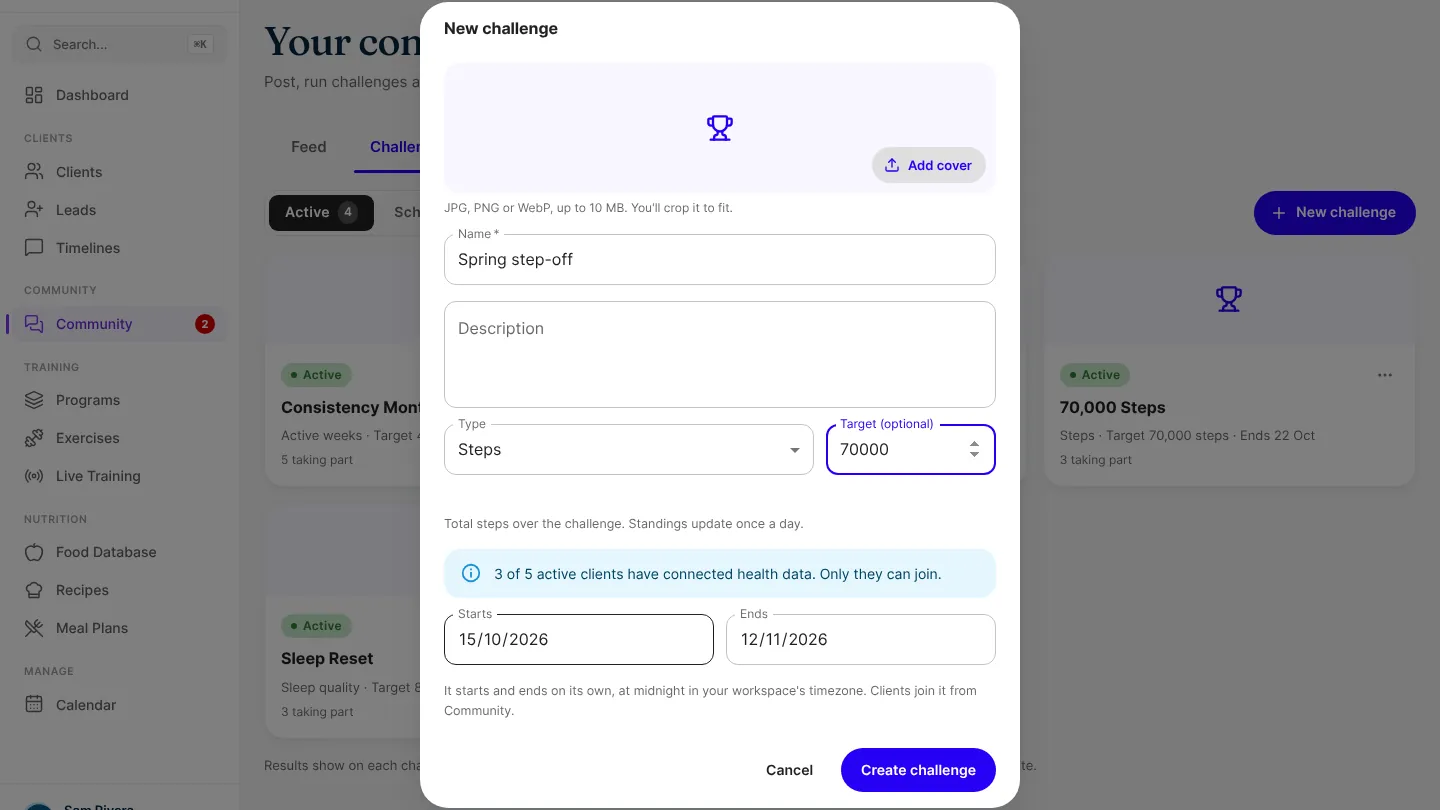
Run a steps, active calories or sleep quality challenge for your clients
Community challenges can now count steps, active calories or sleep quality. Set the dates, and clients who've connected their health data in the app can join.

The Exercises Coaches Are Programming Less (And What Replaced Them)
Nothing was banned. Five once-standard movements sit at the thin end of premium programming now: the crunch, the upright row, behind-the-neck work, good mornings and unstable-surface loading.

The Movements Every Coach Programs, Whatever the Goal
Powerlifting, physique, rehab, CrossFit: the specialties barely resemble each other. Across 70,000 logged workouts, the same five movement patterns sit under all of them.