
How Many Sets Per Exercise Do Coaches Program?
Three sets of ten is the gym default. Across every set premium coaches prescribed on FitFocus in October 2026, the average was closer to two and a half per exercise, and the reason is weekly volume.
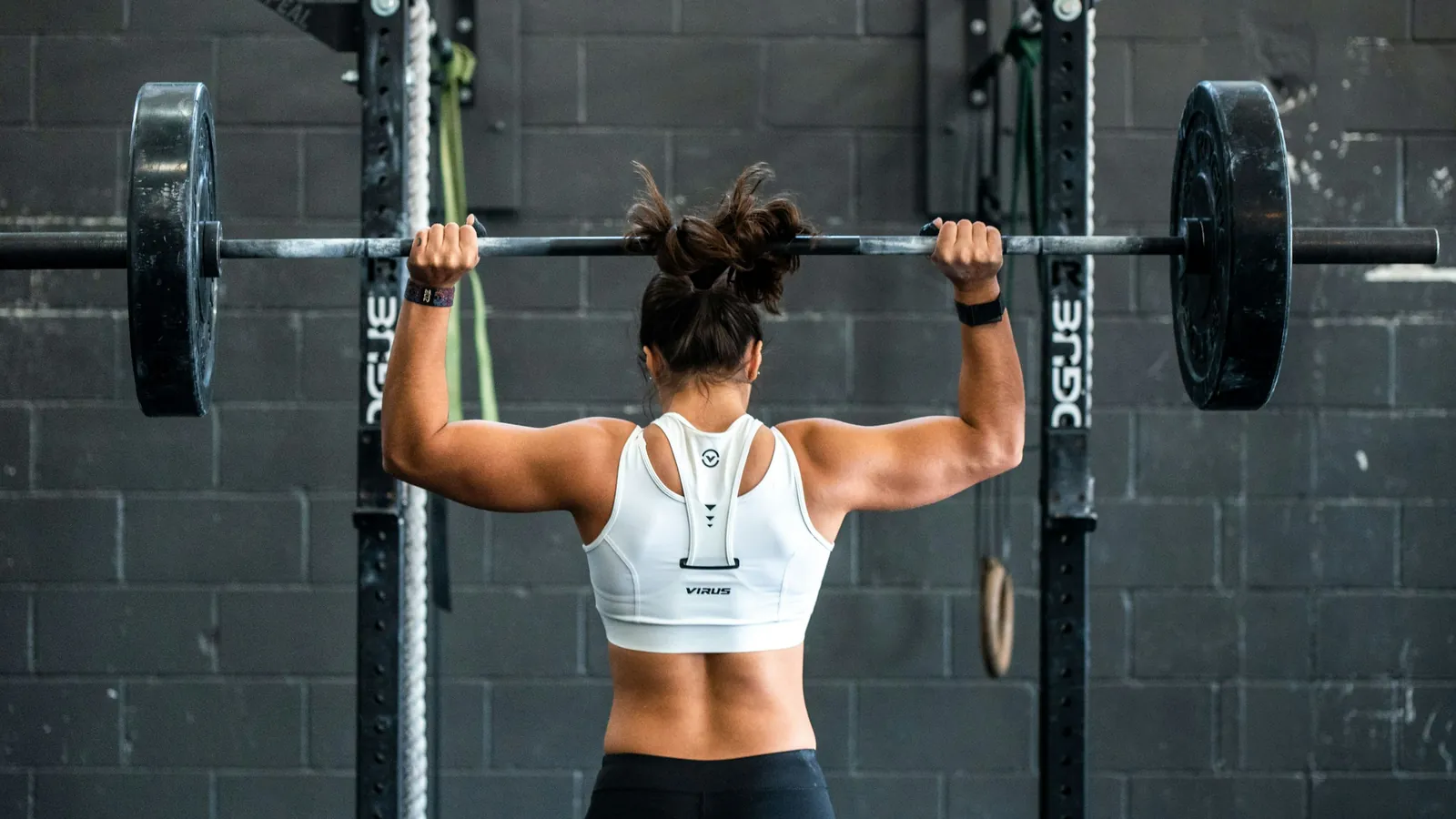
Photo by John Arano on Unsplash
Ask a gym how many sets per exercise to do and the answer is usually three, sometimes four. Ask the data and the answer is lower. Across every set that premium coaches wrote into client programs on FitFocus in October 2026, the average exercise got 2.65 sets.
That is not coaches being stingy. It is what happens when a program is built around weekly volume per muscle instead of a fixed number per movement. This report sets out what the data shows, what moves the number up and down, and what the research says about it. It reads alongside our report on what coaches programmed in October 2026, which covers which exercises those sets went to.
How many sets per exercise do coaches program?
Two to three, most of the time. In October 2026, coaches on FitFocus averaged 2.65 sets per exercise. Exercises averaging two to three sets made up 55% of prescriptions, and four or more was rare at under 7%. Heavy barbell and Olympic lifts got the most sets; isolation and mobility work the fewest.
| Average sets per exercise | Share of prescriptions |
|---|---|
| Under 2 | 11.3% |
| 2 to under 3 | 54.7% |
| 3 to under 4 | 27.5% |
| 4 or more | 6.5% |
The heavy lifts get more sets, the small ones get fewer
Break the average down by type of exercise and a clear gradient appears.
| Exercise group | Average sets per prescription |
|---|---|
| Olympic lifts and derivatives | 3.8 |
| Barbell squats (back, front, safety bar) | 3.5 |
| Jumps and plyometrics | 3.0 |
| Rows | 2.9 |
| Barbell and trap bar deadlifts | 2.9 |
| Lat pulldowns | 2.8 |
| Hip thrusts | 2.7 |
| Romanian deadlifts | 2.7 |
| Leg press and hack squat | 2.7 |
| Core (planks, dead bugs, Pallof presses, crunches) | 2.7 |
| Bench press | 2.6 |
| Lateral raises | 2.6 |
| Split squats and lunges | 2.6 |
| Calf raises | 2.6 |
| Triceps work | 2.6 |
| Leg curls | 2.5 |
| Leg extensions | 2.5 |
| Biceps curls | 2.4 |
| Mobility, release and warm-up drills | 1.6 |
The skill lifts sit at the top for a reason. A snatch or a heavy front squat is practised as much as it is trained, and practice needs repetitions of the whole movement at a load where technique holds. That means more sets of fewer reps. The Olympic figure comes mostly from weightlifting-focused programs, which our report on how Olympic weightlifting coaches program covers in detail.
The bench press is the odd one out. It averaged 2.6 sets, no more than a lateral raise. Most coaches on the platform write it as one press among several in a hypertrophy program rather than as a strength lift to be practised, and the set count shows it.
The same lift, written two ways
The back squat shows how much context matters. Entries named "Back Squat" and "Front Squat", which come mostly from strength-focused programs, averaged close to four sets. The "Barbell Back Squat" entry, which turns up across a much broader mix of programs, averaged 2.4. Same lift. The likeliest reading is that one kind of coach writes the squat as the main event of the session and another writes it as one of five or six exercises.
Why coaches program fewer sets than the textbook
The old "three to four sets per exercise" advice made sense when a typical program had one big lift per muscle. Most programs in the data don't look like that. A lower-body day might include a squat, a Romanian deadlift, a leg extension and a leg curl. Two or three sets of each still adds up to a lot of work per muscle across the week.
That is the unit the research cares about. A 2017 meta-analysis by Schoenfeld, Ogborn and Krieger found a graded dose-response between weekly sets per muscle and muscle growth: each extra weekly set was associated with a little more gain. A later trial in trained men comparing one, three and five sets per exercise found strength improved similarly at every volume while muscle growth rose with more sets.
Put together, that explains the platform average. If the weekly total per muscle is what drives growth, there is little reason to pile four sets onto every movement. Spreading two or three sets across several exercises gets the same weekly work, hits the muscle at different angles and lengths, and keeps each session short enough that clients turn up for it. Strength is a different matter: it is more specific, which is why the skill lifts keep their extra sets.
Our view
We think the low average is a good sign. It suggests coaches are programming for the week rather than the session, which is how the evidence says they should. The risk is the opposite failure. Two sets per exercise is plenty when there are four exercises for a muscle across the week, and thin when there is one. A program that copies "two sets" without the exercise count behind it will undershoot.
What this data cannot tell you
We can see how many sets a coach wrote for each exercise. We cannot see the reps, the load, or how close each set was taken to failure, and all three change what a set is worth. Nor can we total weekly sets per muscle from this view, because many exercises train more than one muscle. Treat the averages as a description of how coaches structure a session, not as a volume target.
How to use these numbers
- Count per muscle per week, not per exercise. If your clients do two sets of an exercise, check how many other exercises hit the same muscle that week.
- Give the skill lifts more sets, not more reps. The heavy squat and the Olympic lifts get extra sets because they are practised, and practice works better in short, clean sets.
- Write prep work as prep work. Mobility drills averaged 1.6 sets because they are a single pass. Programming them with working-set numbers inflates the session without adding training.
The structure that makes this work across a team is the template. If set counts live in each coach's head, every client gets a slightly different week. Built into shared templates in a program builder, the volume follows the program, whichever coach is writing it. The same thinking sits behind the exercise pairings coaches use, where two or three movements share the work for one muscle.
Common questions about sets per exercise
Is 3 sets per exercise enough to build muscle?
For most people, yes, provided the muscle gets enough total work across the week. Research links muscle growth to weekly sets per muscle rather than sets per exercise, so three sets of one exercise twice a week, or two sets each of three exercises, can both work. More weekly volume tends to mean more growth.
Are 2 sets per exercise enough?
They can be. Two to three sets per exercise was the most common pattern among premium coaches on FitFocus in October 2026. It works when a muscle is trained by several exercises or on several days, so the weekly total stays high. With one exercise per muscle per week, two sets is light.
Why do strength programs use more sets?
Because the main lifts are practised as skills. Heavy squats and Olympic lifts are written as more sets of fewer reps so each repetition is done fresh and with good technique. In the October 2026 data, barbell squats averaged 3.5 sets and Olympic lifts 3.8, against 2.4 for biceps curls.
Methodology
This report covers exercise prescriptions written into client programs on the FitFocus coaching platform during October 2026, along with the number of sets written for each. Average sets are total prescribed sets divided by prescriptions, using only prescriptions where a set count was recorded. Exercise groups were built by matching exercise names (for example, every name containing "pulldown" is in the lat pulldown group), so a few names may sit in a neighbouring group. The data records sets as written by the coach, not as completed by the client, and it does not include reps, load or effort. Figures are observational and are not a training prescription. No client-identifying information is included. On training volume we drew on Schoenfeld, Ogborn and Krieger (2017) and Schoenfeld and colleagues (2019).
FitFocus lets coaching teams write sets, reps and progressions once, into templates every coach builds from. Book a 30-minute demo to see how it handles your programming.

Written by
FitFocus team
FitFocus writes about coaching software, pricing, and the business of running a premium coaching practice. FitFocus is part of the Hale Health ecosystem.
Keep reading
What Coaches Programmed in October 2026
A month of programming on FitFocus, read as data. Rows reach nearly two in three clients, machines and cables carry the volume, and one movement pattern barely registers.
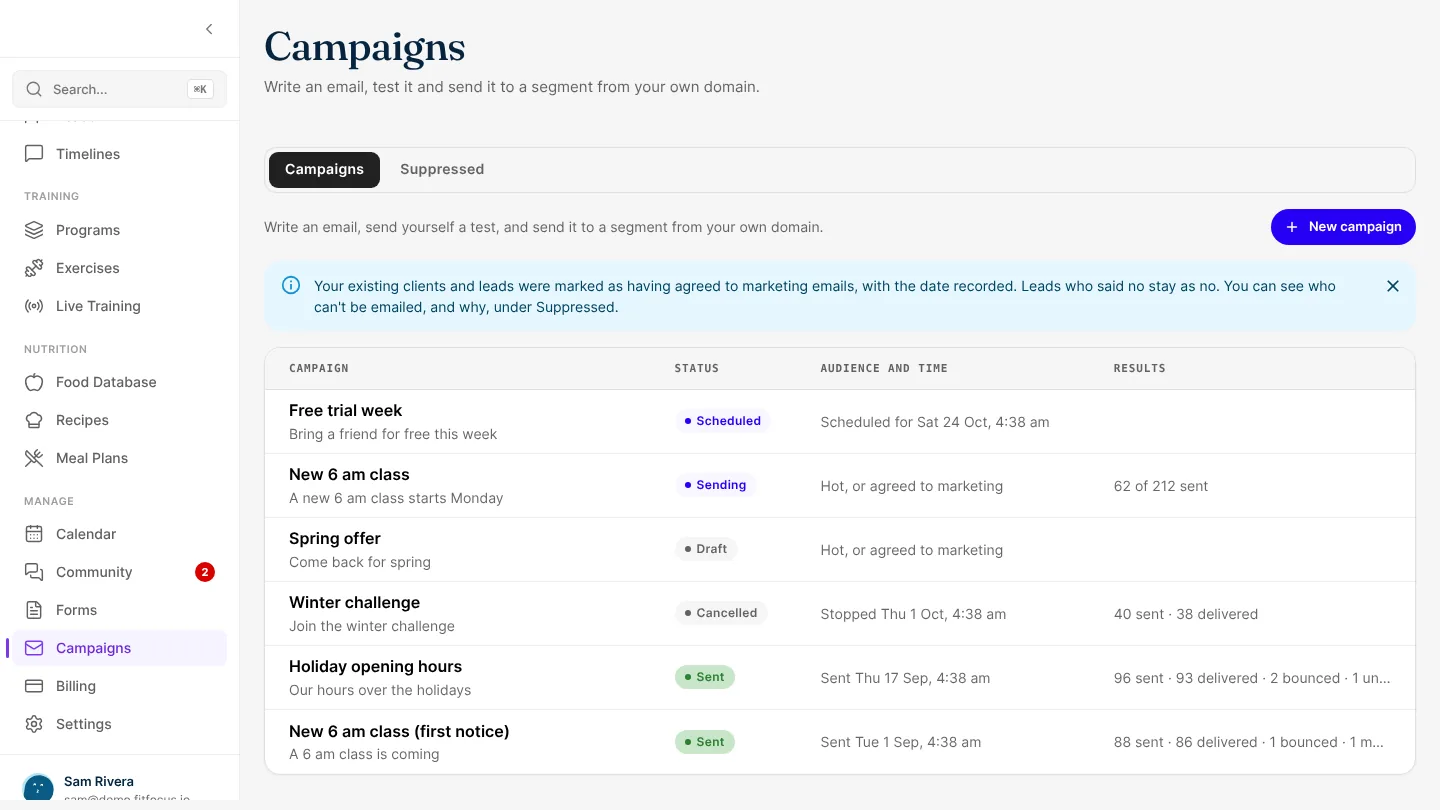
Send campaigns to your leads and clients from your own domain
Write an email in FitFocus, send it to a segment from your own domain, and see what happened. Unsubscribes are honoured at once, and opens are never tracked.
Onboarding a New Coach: The First Thirty Days on Your Team
Most coaching businesses onboard a new coach by shadowing and hope. This is the thirty-day plan that replaces it: a standard-led week one, co-delivery, supervised solo work, and the review that keeps quality after independence.