
What Coaches Programmed in October 2026
A month of programming on FitFocus, read as data. Rows reach nearly two in three clients, machines and cables carry the volume, and one movement pattern barely registers.
Photo by Ambitious Studio* | Rick Barrett on Unsplash
Every exercise a coach writes into a program on FitFocus is a data point. This report reads one month of them: the most programmed exercises of October 2026, which movements show up in the most programs, how the work splits by equipment and movement pattern, and what sits in the long tail.
The figures describe programming patterns across the platform, not individuals, and no client-identifying information is included. A prescription here is one exercise written into one workout. We report shares rather than raw counts.
What were the most programmed exercises in October 2026?
The row was the most programmed exercise in October 2026, written into nearly two in three client programs on FitFocus. The lat pulldown followed at about half. Next came a cluster reaching roughly a third of clients each: the bench press, deadlift, leg extension, Romanian deadlift, back squat and hip thrust.
| Rank | Movement | Share of clients programmed it |
|---|---|---|
| 1 | Row (all variations) | 64% |
| 2 | Lat pulldown | 51% |
| 3 | Bench press | 36% |
| 4 | Deadlift | 36% |
| 5 | Leg extension | 35% |
| 6 | Romanian deadlift | 33% |
| 7 | Back squat | 33% |
| 8 | Hip thrust | 31% |
| 9 | Hamstring curl | 29% |
| 10 | Shoulder press | 27% |
Only eleven movements reached a quarter of clients or more. Forty-four reached at least one in ten. Below that the list thins out fast, and the bottom of it is where the interesting coaching lives.
The row is the most widely shared movement
The gap at the top is the first thing worth noticing. A row of some kind went to nearly two in three clients. The bench press, the lift most gym culture still treats as the headline upper-body exercise, went to just over one in three. Add the lat pulldown at half the roster and pulling is plainly where coaches start an upper-body program.
The same lean shows up in the movement-pattern totals below, though more narrowly. It is also consistent with what we found when we looked at the exercises coaches pair together: the press-and-row couple is the tightest pairing in the data, and in October the row side of it travelled further.
Machines and cables carry the volume
About 27% of prescriptions name no equipment at all, usually because the exercise name does the job on its own ("Plank", "Back Squat"). Among the rest, the split looks like this.
| Equipment | Share of prescriptions with equipment recorded |
|---|---|
| Bodyweight | 20.7% |
| Machine | 18.8% |
| Cable | 15.7% |
| Dumbbell | 15.6% |
| Barbell | 13.7% |
| Other | 9.4% |
| Band | 3.2% |
| Trap bar | 1.1% |
| Kettlebell | 1.0% |
| Landmine, sled, plate, suspension | 0.7% combined |
Machines and cables together account for more than a third of the equipped work, well over twice the barbell's share. That matches the longer-run picture in what premium coaches actually program, where machines and cables already sat at the top. October did not move it. The kettlebell at 1% is the surprise for anyone who trained through the kettlebell boom of the last decade.
Movement patterns: pull edges push, carries almost vanish
| Pattern | Share of prescriptions |
|---|---|
| Pull | 18.8% |
| Push | 17.3% |
| Other (isolation, calves, accessories) | 15.1% |
| Mobility | 11.1% |
| Hinge | 10.7% |
| Core | 9.9% |
| Squat | 8.8% |
| Conditioning | 3.9% |
| Lunge | 3.9% |
| Carry | 0.5% |
Two numbers stand out. Mobility, at 11%, outweighs squatting. That fits what we saw in what coaches do before the working sets: the prep block is real work, not a footnote. The other is the last row. Loaded carries made up half of one per cent of everything prescribed, a long way behind even the next-smallest patterns. If one pattern deserves a hard look from coaches, it is that one.
Single-leg work is thinner than the "train unilaterally" advice of the past decade would suggest, too. The lunge pattern came to 3.9% of prescriptions, against 8.8% for squatting.
The long tail is where the specialists show up
The top ten movements account for 22% of all prescriptions and the top fifty for 54%. The rest is spread across hundreds of movements, and about a fifth of all prescriptions went to movements we class as uncommon or novel.
That tail is not noise. It is where the specialist movements live:
- Weightlifting derivatives. Snatches, clean and jerks, snatch balances, clean pulls and panda pulls together make up a visible slice of the month. Our report on how Olympic weightlifting coaches program explains why the derivatives outnumber the full lifts.
- Soft-tissue and release work. Biceps, posterior cuff, pec, rhomboid and lat release drills are written again and again into the same programs. That is a protocol repeated every session, the signature of rehab-led programming.
- Single-leg hinges and adductor work. The kickstand hinge and the Copenhagen plank each appear in a few per cent of programs, enough to show they have moved from the physio clinic into ordinary training.
- Plyometrics with constraints. Low-ceiling split squat jumps, slalom leaps and depth drops, the kind of jump training that athletic-development coaches write for field-sport clients.
Read the tail and you can guess what kind of coaching each line belongs to. Read the head of the list and it all looks broadly alike, which is the same pattern we found in the movements every coach programs.
Three numbers to check against your own roster
A platform average is only useful against your own programs. These are the three October figures we would compare first.
- Row reach: 64%. If a row is in far fewer of your clients' programs than that, check whether your upper-body days lean on pressing.
- Carry share: 0.5%. Almost nobody programs carries. If you do, you are an outlier, in a direction we think is right.
- Mobility share: 11%. If your prep work lives in a sentence at the top of the session rather than in the program itself, it is invisible to the client and to anyone covering for you.
Each of those depends on being able to see what your team actually wrote last month. A shared program builder with one exercise library is what makes that a five-minute check instead of an afternoon of spreadsheets.
Common questions about what coaches programmed in October 2026
What is the most popular exercise coaches program?
In October 2026 it was the row. Some variation of it went to nearly two in three clients on FitFocus, more than any other movement. The lat pulldown was second at about half. As a single exercise entry, the leg extension was the most prescribed, written more often than any other individual exercise name.
Do coaches still program the bench press?
Yes, but less widely than the row. The bench press reached about 36% of clients in October 2026, third on the list. Most upper-body programs now lead with a pull and treat the bench as one press among several, alongside the shoulder press, incline press and push-up.
How much of a training program is mobility work?
Across FitFocus in October 2026, mobility made up about 11% of all exercise prescriptions, more than squatting at 9%. Most of it sits in the prep block before the working sets, and a smaller share is repeated release or rehab work for a specific group of clients.
Methodology
This report covers exercise prescriptions written into client programs on the FitFocus coaching platform during October 2026. Exercise names were grouped into canonical movements (so "Neutral Grip Lat Pulldown" and "Lat pull down" both count as a lat pulldown), each canonical movement was assigned a movement pattern, and equipment was taken from the exercise record where one exists. Client reach is the share of clients with at least one prescription of the movement during the month. Movements prescribed fewer than eight times in the month are excluded from the canonical figures. The figures are observational, describe programming rather than outcomes, and are not a coaching prescription. No client-identifying information is included.
FitFocus gives coaching teams one exercise library and one program builder, so a month of programming can be read as a whole. Book a 30-minute demo to see it with your own roster.

Written by
FitFocus team
FitFocus writes about coaching software, pricing, and the business of running a premium coaching practice. FitFocus is part of the Hale Health ecosystem.
Keep reading
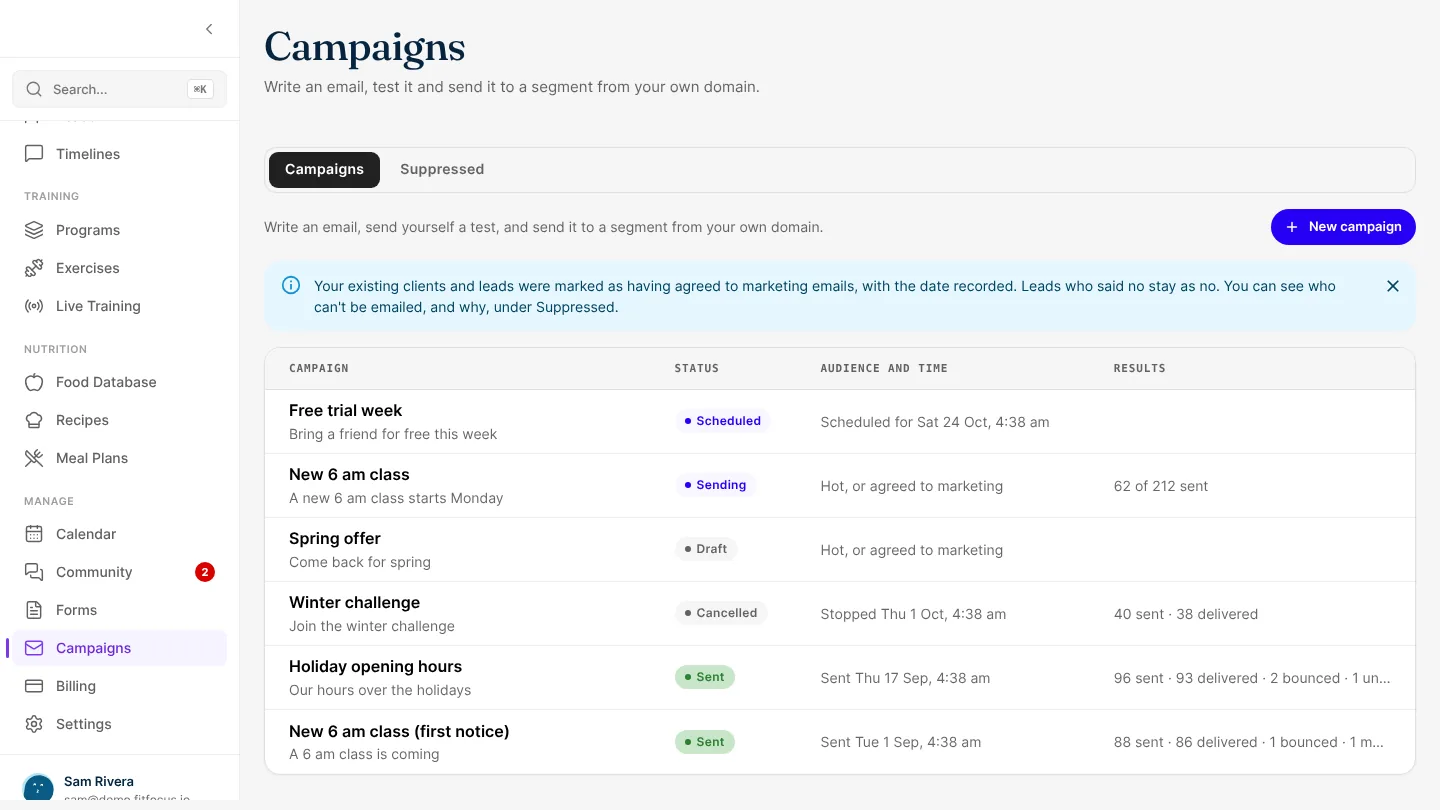
Send campaigns to your leads and clients from your own domain
Write an email in FitFocus, send it to a segment from your own domain, and see what happened. Unsubscribes are honoured at once, and opens are never tracked.
Onboarding a New Coach: The First Thirty Days on Your Team
Most coaching businesses onboard a new coach by shadowing and hope. This is the thirty-day plan that replaces it: a standard-led week one, co-delivery, supervised solo work, and the review that keeps quality after independence.
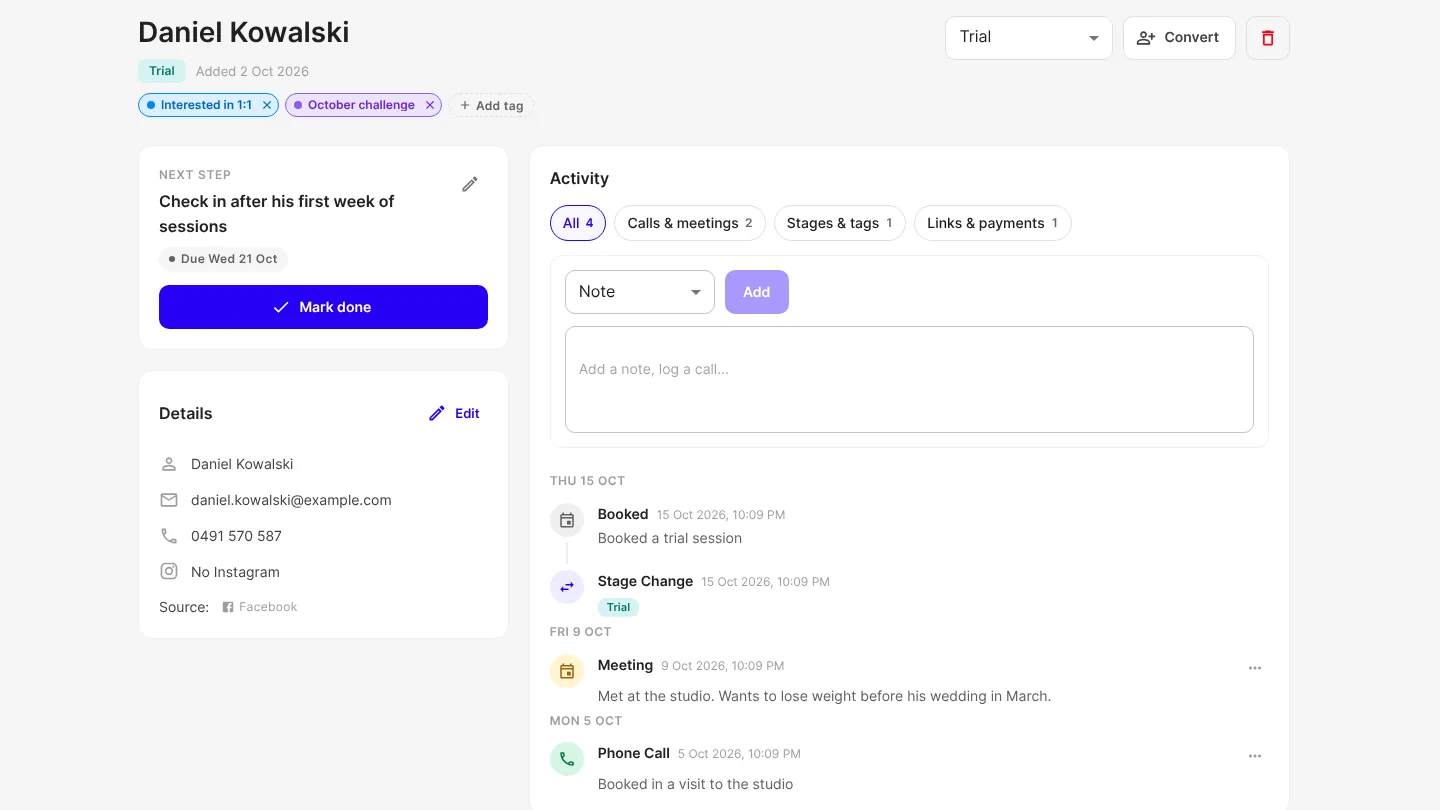
See everything about a contact, and tag and group them
Every lead and client gets one Activity history, and their lead history carries over when they become a client. Tag people, find them by tag and save a group as a segment.