
2,051 Exercise Names in One Month: The Case for One Library
In October 2026, coaches on FitFocus wrote 2,051 differently named exercises, including 20 names for the triceps pushdown alone. Most of that variety is harmless. The duplicates inside one business are not.
Photo by Brett Jordan on Unsplash
In October 2026, coaches on FitFocus wrote 2,051 differently named exercises into client programs. The triceps pushdown alone went by 20 names. "Cable Tricep Pushdown", "Cable Tricep Push Down", "Rope Tricep Pushdowns", "Tricep Rope Pushdowns", "Triceps Pushdown", "Tricep Cable Pushdowns" and fourteen more.
This is an opinion piece about exercise library naming conventions, built on that month of data. Most of the variety is harmless. The part that isn't costs coaching teams more than they notice, and it is cheap to fix.
Why do exercise names matter for a coaching business?
Because the name is how the history is stored. When one movement goes by several names, a client's progress splits across them, a covering coach can't tell what was done, and nobody can see what the team actually programs. A consistent exercise library naming convention keeps every movement on one record.
What the October names look like
Group the 2,051 names by the movement they describe and a little over 500 distinct movements were written eight or more times. That gap is the naming problem in one number. (Which movements those were, and how widely each was programmed, is in our report on what coaches programmed in October 2026.) Some patterns from the month:
| What we found | October 2026 |
|---|---|
| Names containing "pulldown" or "pull down" | 33 |
| Names for the triceps pushdown | 20 |
| Pairs of names identical except for capitals, spaces, hyphens or "tricep" against "triceps" | 37 |
| Names using "DB" for dumbbell | 92 |
| Names starting with a lower-case letter | 68 |
| Names prescribed to only one client | 46% |
The near-duplicates are the easiest to spot: "Lat Pulldown" and "Lat pull down", "Dead Bug" and "Deadbug", "Pull up" and "Pullup", "T-bar Row" and "T Bar Row". Then there are entries that aren't exercises at all. "Class". "Technique Work". "Physio Exercise". "10 minute core". And a few that carry the prescription inside the name, such as "Movement Prep - Roll or trigger ball 5 mins" or "Clean deadlift with 3 second eccentric".
Variety between businesses is fine
Much of the variety comes from the simple fact that different coaching businesses write in different dialects. One practice writes "DB RDL", another "Dumbbell Romanian Deadlift". That is no more a problem than two gyms naming their classes differently. Each business's clients only ever see one dialect.
The trouble starts when the dialects mix inside one business. We can't see from aggregate data exactly how often that happens. But a pair like "Neutral Grip Lat Pulldown" and "Neutral grip lat pull down" almost certainly did not come from two schools of thought. It came from two people typing, or one person typing on two different days.
What a messy library costs a coaching team
Progress tracking breaks
A client who did "Lat Pulldown" for eight weeks and "Lat pull down" for the next four has two short histories instead of one long one. The personal best on the second looks like a fresh start. The coach and the client both lose the trend line that was the point of logging.
Hand-overs get harder
When a coach is away or leaves, the covering coach reads the program cold. "SAS Part 1" meant something to the person who wrote it. To anyone else it is a puzzle, and a client handed to a new coach notices when the new coach can't read their own program. Our guide to handing clients to another coach covers the rest of that process; a clean library is the part that has to exist before the day it's needed.
Templates drift
Every new spelling is usually a sign that someone typed an exercise in instead of picking it from the library. Do that across a team for a year and the house templates fork into personal versions. That is the governance problem we wrote about in programming template governance for coaching teams, starting at the smallest possible unit.
Nobody can see what the team programs
An owner who wants to know how many clients are doing any pulling at all, or whether anyone is programming loaded carries, needs every row to count as a row. With 33 names for a pulldown, that question becomes a spreadsheet project. With one, it is a filter.
An exercise library naming convention that works
There is no single right standard. There is a right habit: pick one, write it down, and make the library the only way exercises get into a program. This is the convention we would start from.
- Equipment, then variation, then movement. "Dumbbell Incline Bench Press", "Cable Single Arm Row", "Barbell Romanian Deadlift". Read left to right, the name sorts sensibly and the equipment is never missing.
- No abbreviations. "Dumbbell", not "DB". "Single Arm", not "SA". Abbreviations save a second for the writer and cost one for every reader, including clients.
- Singular and title case. "Push-Up", not "Push ups" or "pushups". Pick a hyphen rule and keep it.
- Keep the prescription out of the name. Tempo, duration, sets and cues belong in the prescription and the notes. "Clean Deadlift" with a 3-second eccentric in the tempo field is one exercise; three tempo variants in the name are three.
- A variation is a new exercise only when it changes the movement. Grip width, a stance change or a different implement: new entry. A different rep target: same entry.
- Sessions are not exercises. "Class" and "Technique Work" belong in the schedule or the session notes, not in the exercise list.
Where the library has to live
A naming convention only holds if it lives somewhere the whole team writes from. In FitFocus the exercise library and the templates belong to the business rather than to each coach. The library starts with 165 exercises, each with a demo video, and coaches add their own movements and clips to the same shared list, with alternatives set for each exercise. That is the structure behind a shared program builder: one name per movement, picked rather than typed.
It also makes the client record one continuous history rather than a set of fragments, which is the argument of keeping one client record across a coaching team. Start with the movements your team writes most. If your top twenty exercises each have exactly one name by the end of the month, most of the history problem is already solved.
Common questions about exercise library naming
How should you name exercises in a program?
Use one consistent pattern, such as equipment, then variation, then movement ("Dumbbell Incline Bench Press"). Avoid abbreviations, keep sets, tempo and cues out of the name, and add a new entry only when the movement itself changes. Most of all, pick exercises from a shared library rather than typing them in.
Should exercise names include the equipment?
Yes, whenever the equipment changes the movement. A barbell, dumbbell and cable row train the same pattern differently and should be tracked separately. In October 2026, more than a quarter of prescriptions on FitFocus named no equipment at all, which makes it hard to tell later what a client actually lifted.
What is an exercise library in coaching software?
It is the shared list of exercises a coaching business programs from, usually with a demo video, instructions and default settings for each. A good library gives every movement one name, so programs, templates and client histories all point to the same record whichever coach writes the program.
Methodology
This piece uses the exercise names written into client programs on the FitFocus coaching platform during October 2026. Name counts are of distinct names as coaches wrote them. "Identical except for formatting" pairs were found by lower-casing names, removing spaces and punctuation and treating "tricep" and "triceps" as the same; plural forms were not merged, so the true number of near-duplicates is higher. Canonical movement counts include only movements prescribed at least eight times in the month. No client-identifying information is included, and no individual business's library is described.
FitFocus gives coaching teams one shared exercise library with demo videos and shared templates, so a movement has one name across the whole business. Book a 30-minute demo to see it.

Written by
FitFocus team
FitFocus writes about coaching software, pricing, and the business of running a premium coaching practice. FitFocus is part of the Hale Health ecosystem.
Keep reading
Coaches Barely Program Loaded Carries. That's a Mistake.
Pick up something heavy and walk. It is one of the oldest training ideas there is, and in October 2026 it made up half of one per cent of everything premium coaches programmed on FitFocus. We think that is a mistake.
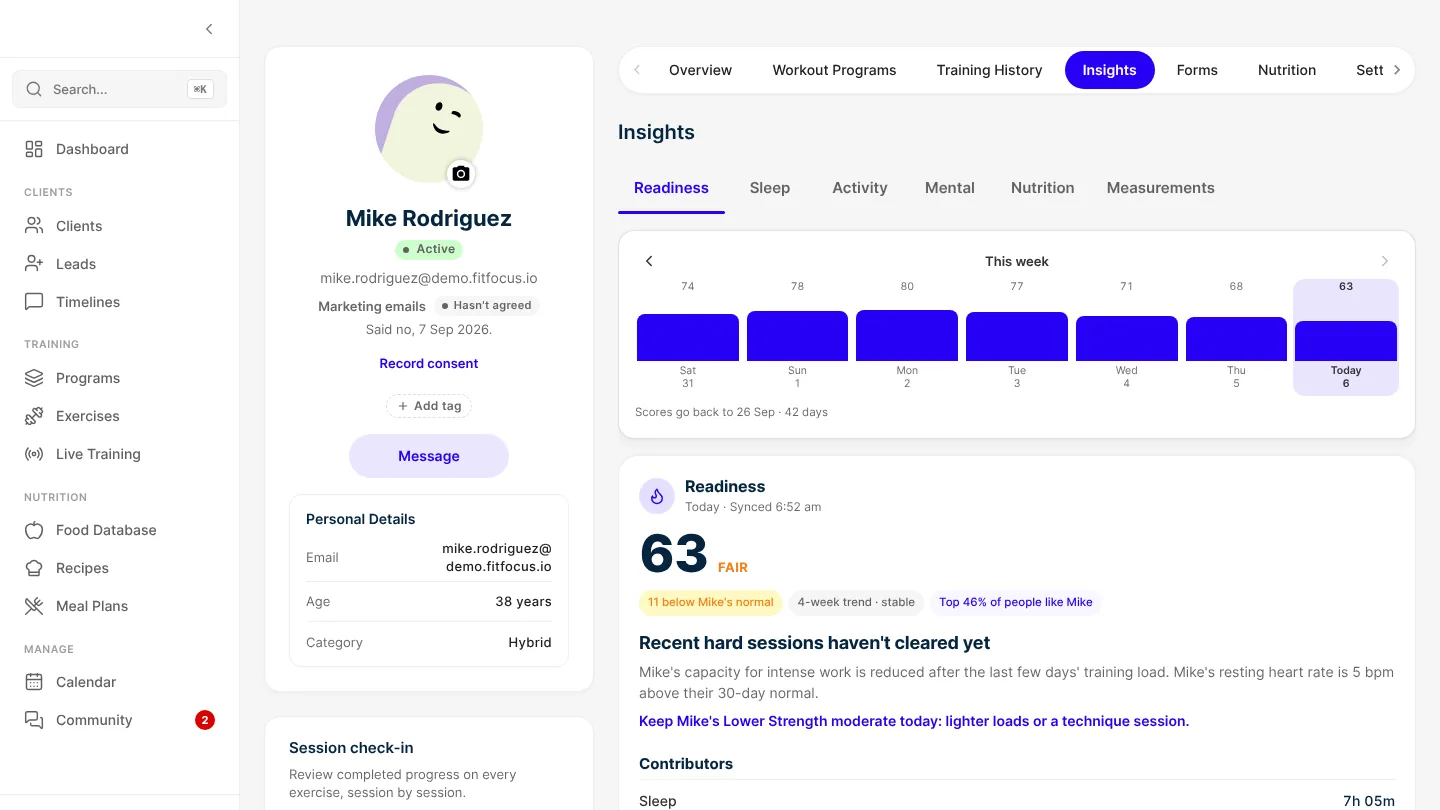
Health Insights now explain every score
Each readiness, sleep, activity and mental wellbeing score now names its cause, shows what's behind it and says what to do today, for clients and their coach.
The Leg Extension Is Coaching's Favourite Exercise. It Earned It.
The machine that gym purists love to mock was the most prescribed single exercise on FitFocus in October 2026. We think it earned the spot, and the knee worry that follows it around is mostly out of date.